


Stanford AI resources for students can be a great starting point for anyone who wants to learn artificial intelligence from high-quality courses, lectures, research materials, and practical projects. Stanford offers a wide range of AI learning resources for beginners, students, and aspiring researchers.
Whether you’re studying computer science, software engineering, data science, mathematics, or another field, having a basic understanding of AI can help you work on better projects, explore research opportunities, and prepare for an increasingly AI-focused job market.
The difficult part is knowing where to start.
There are thousands of AI tutorials, YouTube videos, online courses, and learning platforms available. Some are excellent, while others make AI look much easier than it really is.
Stanford is one of the places worth exploring if you want a more structured, university-level approach to learning AI.
Stanford’s AI Lab course collection includes resources covering artificial intelligence, machine learning, deep learning, natural language processing, reinforcement learning, generative models, robotics, and more. Stanford’s Computer Science department also offers AI as one of its undergraduate tracks, with courses such as CS221, CS224N, and CS229.
The good news is that students outside Stanford can find a significant amount of publicly available material online.
The important part is knowing which resources to use, what level they are aimed at, and how they fit together.
That’s what this guide is about.
What Stanford AI Resources for Students Can You Access?
Stanford’s AI resources aren’t limited to one introductory course.
Depending on your interests, you can explore topics including:
- Artificial intelligence
- Machine learning
- Deep learning
- Natural language processing
- Computer vision
- Reinforcement learning
- Generative models
- Robotics
- Probabilistic modeling
- Machine learning theory
- AI applications
- AI research
Stanford’s AI Lab currently lists a wide range of course introductions, including CS221, CS229, CS230, CS224N, CS234, CS236, CS330, CS224W, and several other specialized courses.
That variety is useful, but it can also be confusing for someone who is just getting started.
For example, a beginner who wants to learn AI might not benefit from immediately jumping into an advanced NLP or reinforcement learning course.
A better strategy is to understand the purpose of each course and then choose one based on your current skills.
Best Stanford AI Courses for Students
These Stanford AI resources for students include courses covering artificial intelligence, machine learning, deep learning, natural language processing, reinforcement learning, and generative AI.
1. CS221 – Artificial Intelligence: Principles and Techniques
If you want to understand artificial intelligence as a broad field rather than focusing immediately on one technique, CS221 is an important course to explore.
Stanford’s AI Lab lists CS221 as Artificial Intelligence: Principles and Techniques, and Stanford’s Computer Science department includes it among the sample courses in its Artificial Intelligence track.
The broader AI track at Stanford covers areas including logic, probability, statistics, language, reasoning, robotics, machine learning, probabilistic modeling, natural language processing, computer vision, and other applications.
That gives you an idea of how broad AI actually is.
Who is CS221 for?
CS221 makes sense for students who want to build a general understanding of AI before deciding on a specialization.
It can be particularly useful if you’re asking questions like:
- How do intelligent systems make decisions?
- How can computers reason about problems?
- How does machine learning fit into AI?
- How are AI systems designed to solve real-world problems?
If you’re completely new to programming and mathematics, though, you may want to strengthen those foundations before taking on university-level AI material.
2. CS229 – Machine Learning
Once you’re interested specifically in machine learning, Stanford’s CS229 is one of the courses worth knowing about.
Machine learning is a major part of modern AI. Instead of explicitly programming every rule, machine-learning systems learn patterns from data and use those patterns to make predictions or decisions.
CS229 is included in Stanford’s AI Lab course collection and is also listed by Stanford Computer Science as a sample class in the Artificial Intelligence track.
Students exploring machine learning will encounter concepts related to areas such as:
- Supervised learning
- Unsupervised learning
- Regression
- Classification
- Optimization
- Statistical learning
- Machine-learning algorithms
Is CS229 a beginner course?
It is better approached as a course for students who already have some technical foundation.
Before jumping into advanced machine learning material, it helps to be comfortable with:
- Python or another programming language
- Basic probability
- Linear algebra
- Statistics
- Fundamental computer science concepts
If those topics are unfamiliar, spending some time on them first can make the learning experience much less frustrating.
3. CS230 – Deep Learning
If machine learning is the foundation, deep learning is one of the major technologies built on top of it.
CS230: Deep Learning focuses on the foundations of deep learning, neural networks, and practical machine-learning projects. Stanford’s current course page lists topics including convolutional networks, RNNs, LSTMs, optimization techniques, dropout, batch normalization, and related concepts.
The course is also strongly project-oriented.
The current CS230 structure includes lectures, programming assignments, quizzes, and a final project. Its syllabus shows students working through deep-learning material alongside programming exercises and project development.
This is one reason CS230 can be particularly interesting for students who don’t want to study AI only from a theoretical perspective.
What can you learn from CS230?
Depending on the course material and offering, you can encounter topics such as:
- Neural networks
- Deep learning fundamentals
- Convolutional neural networks
- Recurrent neural networks
- Optimization
- Model regularization
- Machine-learning project strategy
- Practical deep-learning applications
Stanford also provides public CS230 lecture resources from an earlier offering. These include lectures on deep-learning intuition, project strategy, interpretability, deep reinforcement learning, and chatbots.
Who should study CS230?
CS230 is a better choice once you’ve developed a reasonable foundation in programming, mathematics, and basic machine learning.
The current course page lists probability, statistics, linear algebra, and basic computer-science/programming knowledge among its expected background.
4. CS224N – Natural Language Processing with Deep Learning
If your interests are closer to ChatGPT, language models, NLP, or LLMs, CS224N deserves special attention.
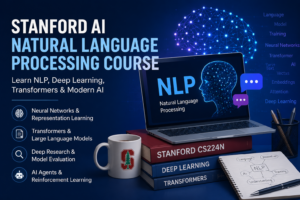
Stanford’s CS224N: Natural Language Processing with Deep Learning focuses on modern neural-network approaches to natural language processing. The Winter 2026 course describes NLP as an important part of AI and introduces students to current neural approaches for NLP.
This makes it especially relevant for students who want to understand the technology behind modern language-based AI systems.
Topics in this area can include:
- Natural language processing
- Neural networks
- Word representations
- Attention
- Transformers
- Language models
- Modern NLP research
- Large language models
The course also includes substantial project work.
The Winter 2026 project page, for example, lists projects involving GPT-2 fine-tuning, attention optimization, KV caching, speculative decoding, and other modern language-model topics.
Who should consider CS224N?
It’s a better fit for students who already have programming and mathematical foundations and want to specialize in NLP.
If you’re completely new to AI, don’t feel pressured to start here just because LLMs are popular.
Understanding the fundamentals first will make advanced NLP much easier to follow.
5. CS234 – Reinforcement Learning
Reinforcement learning is another major area of AI.
Instead of simply learning from a fixed dataset, reinforcement learning focuses on agents that make decisions while interacting with an environment.
Stanford’s AI Lab includes CS234: Reinforcement Learning among its AI course resources.
This area can be especially interesting if you’re curious about:
- Robotics
- Autonomous systems
- Game-playing AI
- Sequential decision-making
- Intelligent agents
- Control systems
Reinforcement learning is usually better treated as a specialization rather than the first AI topic a complete beginner studies.
6. CS236 – Deep Generative Models
Generative AI has changed the way many people think about artificial intelligence.
Tools that generate text, images, audio, video, and other content all rely on ideas from generative modeling.
Stanford’s AI Lab lists CS236: Deep Generative Models among its AI course resources.
A course in this area can help students understand the ideas behind models that learn the underlying structure of data and generate new samples.
Generative-model concepts can connect to areas such as:
- Generative AI
- Deep learning
- Probabilistic modeling
- Representation learning
- Image generation
- Language generation
If you’re interested in today’s generative AI systems, this is an area worth exploring—but advanced generative modeling is much easier to understand after you’ve built a strong machine-learning and deep-learning foundation.
If you’re also interested in practical AI applications for studying, you can explore our guide to Generative AI Tools for Students.
Stanford AI Lectures and Public Learning Materials
For students building a self-study plan, these Stanford AI resources can provide a useful university-level learning structure.
One of the most useful things about Stanford’s online course ecosystem is that individual course websites can provide additional learning materials.
Depending on the course and offering, you may find:
- Lecture notes
- Video lectures
- Assignments
- Project instructions
- Reading materials
- Tutorials
- Course schedules
- Supplementary resources
For example, Stanford’s CS230 website provides a public lecture archive from an earlier offering, while the current course page explains that current course recordings are provided through Canvas/Panopto for enrolled students.
This distinction matters.
You may be able to learn a great deal from Stanford without enrolling, but you shouldn’t assume that every current lecture, assignment, discussion forum, or course platform is publicly accessible.
Are Stanford AI Resources Free?
This question needs a little nuance.
Some Stanford AI resources are publicly available, but not every part of every Stanford AI course is free and open to everyone.
This makes Stanford AI resources for students particularly useful for independent learners who want access to university-level material without necessarily enrolling at Stanford.
For independent learners, publicly accessible materials may include:
- Course websites
- Selected lecture notes
- Previous lecture recordings
- Public assignments
- Project descriptions
- Tutorials
- Reading resources
At the same time, some current course resources are intended for enrolled students.
CS230 is a good example. Its public website provides older lecture recordings, while the current course page says current course videos are available through the course’s Canvas/Panopto system.
So if you see someone claiming that “all Stanford AI courses are completely free,” take that statement with caution.
A more accurate description is:
Stanford provides a valuable collection of publicly accessible AI learning resources, but access varies from course to course.
Can You Learn AI From Stanford Without Being a Stanford Student?
Yes—at least to a significant extent.
You can use publicly available Stanford course pages, lecture materials, tutorials, assignments, and other resources to build your own AI learning path.
But there is an important difference between learning from Stanford’s public materials and being enrolled in a Stanford course.
As an independent learner, you may not have access to things such as:
- Private course forums
- Current enrolled-student lecture recordings
- Grading
- Instructor feedback
- Office hours
- Private course platforms
- Academic credit
That doesn’t make the public resources less valuable.
In fact, for a motivated student, they can provide an excellent framework for self-study.
The key is to supplement them with hands-on practice.
Stanford AI Resources for Beginners
If you’re looking for Stanford AI resources for students who are just starting, don’t make the common mistake of choosing an advanced Stanford course simply because its title sounds impressive.
AI has a learning curve.
A more realistic path looks something like this.
Step 1: Learn Programming
Python is a particularly useful language for AI and machine learning.
You should be comfortable with:
- Variables
- Functions
- Loops
- Lists and dictionaries
- Classes
- File handling
- Basic debugging
- Working with libraries
You don’t need to become an expert programmer before touching AI, but basic programming skills will make everything else easier.
Step 2: Build Your Math Foundation
You don’t need advanced mathematics for every AI application.
However, mathematics becomes increasingly important as you move into university-level machine learning and deep learning.
Start with:
- Linear algebra
- Probability
- Statistics
- Basic calculus
- Optimization
The goal isn’t to memorize formulas.
It’s to understand what the mathematics is doing inside an AI model.
Step 3: Learn AI Fundamentals
Once your programming foundation is comfortable, explore introductory AI material.
CS221 is one Stanford resource worth investigating because it provides a broad look at artificial intelligence rather than focusing on one narrow application.
Step 4: Move Into Machine Learning
After learning the basics of AI, explore machine learning.
This is where a course such as CS229 becomes more relevant.
You’ll start thinking about how models learn from data rather than simply how computers solve predefined problems.
Step 5: Learn Deep Learning
Next, move toward neural networks and deep learning.
CS230 is a natural resource to explore at this stage. Its course material covers the foundations of deep learning and practical machine-learning project development.
Step 6: Choose a Specialization
At this point, you don’t need to learn every branch of AI.
Choose the one that matches your interests.
Interested in language and LLMs?
Explore CS224N.
Interested in generative AI?
Explore CS236 and related deep-learning material.
Interested in autonomous decision-making?
Look into CS234.
Interested in broader AI?
Continue exploring the Stanford AI course collection.
Stanford’s AI Lab provides a useful overview of these different directions.
A Practical Stanford AI Learning Roadmap
Here’s a simple way to organize the journey:
Python → Mathematics → AI Fundamentals → Machine Learning → Deep Learning → Specialization → Projects → Research
Stage 1: Programming
Learn Python and fundamental computer-science concepts.
Stage 2: Mathematics
Study enough linear algebra, probability, statistics, and calculus to understand machine-learning concepts.
Stage 3: AI Fundamentals
Explore introductory AI concepts such as those covered by CS221.
Stage 4: Machine Learning
Move toward machine-learning foundations with resources such as CS229.
Stage 5: Deep Learning
Study neural networks and deep-learning techniques through resources such as CS230.
Stage 6: Specialization
Pick one direction:
- NLP
- Generative AI
- Computer vision
- Reinforcement learning
- Robotics
- AI research
Stage 7: Projects
This is where your learning becomes practical.
Instead of watching another ten hours of lectures, try building something.
For example:
- A document summarizer
- An AI study assistant
- An image classifier
- A recommendation system
- A simple chatbot
- A text classification model
- A small RAG application
Your first project doesn’t need to be revolutionary.
It just needs to make you use what you’ve learned.
Which Stanford AI Course Should You Start With?
There isn’t one Stanford AI course that’s perfect for everyone.
Your starting point should depend on your goal and current background.
| If you want to learn… | A Stanford resource to explore |
|---|---|
| AI fundamentals | CS221 |
| Machine learning | CS229 |
| Deep learning | CS230 |
| NLP and language models | CS224N |
| Reinforcement learning | CS234 |
| Deep generative models | CS236 |
| Advanced AI topics | Stanford AI Lab course collection |
These courses aren’t interchangeable.
Someone interested in language models may eventually benefit more from CS224N than from spending months studying reinforcement learning.
Likewise, someone interested in robotics may have very different goals from someone interested in generative AI.
Choose based on what you want to build, not just which course has the biggest reputation.
What Should You Know Before Studying Stanford AI Courses?
The prerequisites vary considerably.
For advanced deep-learning coursework, you should expect a stronger technical background.
For example, the current CS230 course lists familiarity with probability, basic statistics and data science, linear algebra, and basic computer-science/programming skills among its expected background.
That doesn’t mean you need to master every prerequisite before starting your AI journey.
It means you should be realistic about your current level.
If you struggle with basic Python, jumping directly into an advanced neural-network course will probably feel overwhelming.
Instead, fill the gaps as you go.
A good self-check is:
Can I write a basic Python program without following a tutorial line by line?
Do I understand vectors and matrices?
Do I have a basic idea of probability and statistics?
Have I worked with data before?
Do I understand what machine learning is supposed to do?
If several answers are no, that’s completely fine.
It simply means your next step should be foundation-building rather than advanced specialization.
How to Study Stanford AI Resources Effectively
There is a big difference between watching AI content and learning AI.
You can watch dozens of lectures and still struggle to build a simple model.
Try this workflow instead.
1. Learn
Watch a lecture or read the relevant material.
2. Take Notes
Write the main concept in your own words.
3. Practice
Work through an exercise or assignment.
4. Code
Implement the idea yourself.
5. Experiment
Change something and see what happens.
6. Build
Use the concept in a small project.
7. Review
Go back to the parts you didn’t understand.
8. Read Further
Once you’re comfortable, explore papers, documentation, and advanced material.
This process may feel slower than simply watching lectures.
In reality, it usually leads to much deeper understanding.
Stanford AI Resources by Learning Goal
If you’re trying to choose the right Stanford AI resources for students based on your learning goal, you can use the following paths as a starting point.
For AI Fundamentals
Start by exploring CS221 and Stanford’s broader AI course collection.
For Machine Learning
Explore CS229 after developing the required mathematical and programming foundation.
For Deep Learning
Look at CS230, especially if you want both theoretical foundations and practical project experience.
For NLP and LLMs
Explore CS224N, particularly if language models and natural language processing are your main interests.
For Reinforcement Learning
Explore CS234 if you are interested in agents, decision-making, robotics, or sequential learning.
For Generative AI
Explore CS236 alongside strong machine-learning and deep-learning foundations.
Stanford AI Lab and Research Resources
Once you move beyond basic courses, it’s worth looking at Stanford’s broader AI research ecosystem.
The Stanford AI Lab’s course collection is useful because it shows just how many directions AI can take.
Its listed resources span deep learning, NLP, reinforcement learning, generative models, machine learning with graphs, robotics, AI in healthcare, decision-making, statistical learning theory, and other areas.
This can help you answer an important question:
What part of AI do I actually want to specialize in?
You might start by thinking you want to learn “AI” generally.
After exploring different areas, you may discover that you are actually more interested in:
- LLMs
- Computer vision
- Robotics
- AI research
- Generative models
- Healthcare AI
- Machine-learning theory
That specialization can then guide the courses and projects you choose.
If you’re interested in using AI for academic research, you can also explore our guide to Generative AI for Research Students.
Stanford AI Resources vs Other Online Learning Platforms
Stanford isn’t the only place where you can learn AI.
Other well-known options include:
- MIT OpenCourseWare
- DeepLearning.AI
- Google AI resources
- fast.ai
- Open-source documentation
- Research papers
- GitHub projects
The advantage of Stanford’s resources is their connection to a major university computer-science and AI research environment.
But that doesn’t mean Stanford should be your only learning source.
In fact, combining different types of resources can be more effective.
For example:
University lectures can help with theory.
Interactive courses can help with practice.
Documentation can teach you how tools actually work.
Projects can develop your problem-solving skills.
Research papers can introduce you to current ideas.
A good AI learner uses all of these.
Common Mistakes Students Make When Learning AI
Learning AI can be overwhelming, especially when you see new tools and models appearing every week.
Here are a few mistakes worth avoiding.
Trying to Learn Everything at Once
You don’t need to study machine learning, computer vision, NLP, robotics, reinforcement learning, and generative AI simultaneously.
Pick one direction first.
Skipping the Fundamentals
It can be tempting to jump directly into LLM APIs or image-generation tools.
Those tools are useful, but understanding the underlying concepts will help you use them more effectively.
Watching Instead of Practicing
A lecture feels productive.
Writing code is harder.
Do both.
Ignoring Mathematics Completely
You don’t need advanced mathematics for every AI job, but avoiding mathematical concepts entirely can make advanced AI much harder to understand.
Building Projects Without Understanding Them
Copying a GitHub project isn’t the same as learning.
Try changing the code, breaking it, fixing it, and explaining how it works.
That’s where real learning happens.
Frequently Asked Questions
What are the best Stanford AI resources for students?
Some of the most useful resources include Stanford’s AI course collection, CS221, CS229, CS230, CS224N, CS234, and CS236, along with the public materials available through individual course websites.
Can I learn AI from Stanford without being a Stanford student?
Yes. Many Stanford AI course websites and learning materials are publicly accessible, although access varies by course and offering.
Are Stanford AI courses completely free?
Not necessarily. Some lectures, notes, assignments, and other resources are publicly available, while current course platforms and certain materials may be restricted to enrolled students. CS230, for example, distinguishes its public older lecture recordings from current course recordings available through Canvas/Panopto.
Which Stanford AI course is best for beginners?
CS221 is a useful course to explore if you want a broad introduction to artificial intelligence. Your programming and mathematics background should also influence where you begin.
Is CS229 suitable for complete beginners?
It is better approached after developing basic programming and mathematical foundations. If you’re completely new to both Python and mathematics, start with those areas first.
Which Stanford course is best for deep learning?
CS230 is Stanford’s dedicated Deep Learning course and covers neural networks, deep-learning foundations, and practical machine-learning project development.
Which Stanford course should I study for NLP and LLMs?
CS224N is the most directly relevant option among the courses discussed here. Its Winter 2026 offering focuses on Natural Language Processing with Deep Learning and modern neural approaches to NLP.
Does Stanford provide AI lectures online?
Yes, some Stanford AI course materials and lecture recordings are publicly available. However, availability differs by course and year. CS230, for example, has a public archive of lectures from an earlier offering.
Do I need Python to learn AI?
Python is highly useful for AI and machine learning, and learning it before advanced AI coursework will make the process much easier.
Should I learn machine learning before generative AI?
For a deeper technical understanding, yes. You can use generative AI tools without studying machine learning first, but understanding machine learning and deep learning provides a much stronger foundation for understanding how modern AI systems work.
Final Thoughts
Stanford AI resources can be a great starting point for students who want to go beyond surface-level AI tutorials.
You don’t need to enroll at Stanford to benefit from its publicly available learning materials.
What matters more is how you use them.
Don’t try to collect as many courses as possible. Choose resources that match your current level, work through the material carefully, practice what you learn, and build projects along the way.
A practical path could look like this:
Python → Mathematics → AI Fundamentals → Machine Learning → Deep Learning → Specialization → Projects → Research
And remember: you don’t have to become an AI expert overnight.
Start with one concept.
Build one project.
Then move to the next.
That’s a much more sustainable way to learn AI than trying to consume everything at once.
About The Author