


Writing a thesis is a very different experience from writing a short assignment or a research paper.
You have to deal with a research question, literature review, methodology, multiple chapters, references, revisions, formatting, and sometimes hundreds of pages of notes and source material. That is where large language models (LLMs) can become useful.
But there is an important distinction: an LLM should not replace the researcher.
The best LLM for thesis writing is the one that fits the particular stage of your thesis work—whether you need help developing an outline, understanding difficult concepts, organizing notes, improving academic writing, or reviewing a chapter.
In 2026, tools such as ChatGPT, Claude, Gemini, and source-focused research assistants offer different approaches to academic work. Some are better suited to general writing and reasoning, while others are particularly useful when working with large collections of sources.
This guide compares those workflows and explains how to use an LLM for thesis writing without turning your thesis into generic AI-generated text.
If you’re specifically comparing AI models for research papers, you can also read our guide to the best LLMs for research papers.
What Makes an LLM Useful for Thesis Writing?
A thesis usually involves several different tasks, and they don’t all require the same type of AI assistance.
For example, you might use an LLM to:
- Brainstorm possible research questions
- Turn a broad topic into a manageable thesis structure
- Create a chapter outline
- Explain difficult academic concepts
- Summarize notes you’ve already collected
- Compare arguments from different sources
- Improve sentence clarity and academic tone
- Find gaps or inconsistencies in your draft
- Suggest ways to organize a literature review
- Explain statistical or technical concepts
- Review a methodology section
- Check whether different chapters remain consistent
- Prepare questions for a supervisor meeting
This is why choosing an LLM for thesis writing should not simply mean asking, “Which model writes the best?”
A better question is:
Which AI tool works best for the specific part of my thesis I am working on?
Best LLMs for Thesis Writing at a Glance
Different tools can be useful at different stages of thesis work.
| LLM or AI tool | Particularly useful for | Best thesis use |
|---|---|---|
| ChatGPT | Research, brainstorming, outlining, explanations, editing | General thesis workflow |
| Claude | Long-form writing, revision, document analysis | Draft improvement and chapter editing |
| Gemini | Research and Google ecosystem workflows | Research planning and source discovery |
| NotebookLM | Working with user-provided sources | Source-grounded literature review |
| Other specialized AI tools | Specific academic workflows | Citation, organization, or research support |
There is no universal winner because thesis projects differ. A computer science thesis, a literature thesis, and a business dissertation may require completely different workflows.
1. ChatGPT for Thesis Writing
ChatGPT is useful when you want one general-purpose AI assistant throughout different stages of your thesis.
It can help with brainstorming, outlining, explanations, editing, research planning, and working through complicated questions.
OpenAI’s current research guidance describes ChatGPT as useful for gathering and synthesizing information, comparing sources, creating structured reports, and identifying gaps or contradictions. Its Deep Research feature is designed for multi-step research tasks and produces reports with citations or source links.
Where ChatGPT can help with a thesis
Imagine that you have a broad topic such as:
“The impact of generative AI on university students.”
Instead of immediately asking AI to write the thesis, you could ask it to help you break the topic into:
- Research problem
- Research questions
- Objectives
- Possible variables
- Literature-review themes
- Methodology options
- Possible limitations
You can then evaluate those suggestions yourself and discuss appropriate ideas with your supervisor.
ChatGPT can also help turn your approved research question into a chapter structure.
For example:
- Chapter 1 — Introduction
- Chapter 2 — Literature Review
- Chapter 3 — Methodology
- Chapter 4 — Results
- Chapter 5 — Discussion
- Chapter 6 — Conclusion
The exact structure depends on your university and discipline.
ChatGPT for thesis research
One of the more useful features for research-heavy thesis work is Deep Research.
OpenAI says Deep Research can plan a research task, investigate multiple sources, compare evidence, and produce a structured report with citations.
That can be useful during the early research stage when you are trying to understand a topic before reading individual papers in depth.
However, a generated research report should be treated as a starting point—not as a substitute for reading the original academic sources.
2. Claude for Thesis Writing
Claude can be particularly useful when your main problem is working with long pieces of writing.
A thesis can become difficult to manage once you have several chapters, notes, revisions, supervisor comments, and alternative versions.
Instead of asking an AI to create an entire thesis, you can give it a section of your own writing and ask questions such as:
- Is the argument easy to follow?
- Does this paragraph repeat the previous one?
- Is the transition between these sections clear?
- Which sentences sound unnecessarily complicated?
- Where does the argument need more evidence?
- Does this section answer the research question?
This kind of editing assistance is often more useful than simply asking an LLM to “write academically.”
Claude can be useful for revision
Suppose you have written a 2,000-word literature-review section.
Rather than replacing it with AI-generated text, you could ask Claude to identify:
- Repeated ideas
- Weak transitions
- Unclear sentences
- Contradictory statements
- Places where additional evidence may be needed
- You then decide which suggestions to accept.
That keeps the intellectual ownership of the thesis with you.
3. Gemini for Thesis Research
Gemini can be particularly interesting for students who already use Google’s ecosystem.
Google’s current Deep Research feature can conduct in-depth, real-time research and uses Google Search as a default source. It can also work with uploaded files and, where available, NotebookLM notebooks.
This makes Gemini useful during the research-planning stage.
For example, you could ask it to investigate:
“What are the major research themes surrounding AI-assisted learning in higher education? Group the themes and identify areas that appear frequently in recent academic literature.”
The output can help you understand the landscape before you start building your literature review.
But again, don’t treat an AI-generated overview as your final literature review.
Your actual thesis should be based on the academic literature you have personally examined and verified.
4. NotebookLM for Thesis Research
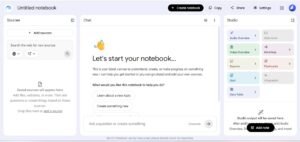
NotebookLM is different from a general chatbot because its workflow is centered around the sources you provide.
This can make it particularly useful when you already have a collection of papers, PDFs, notes, or other research material.
Instead of asking a general AI:
“What does the literature say about this topic?”
you can give a source-grounded tool your selected material and ask questions about those sources.
For a thesis, that can be helpful when you have dozens of papers and want to organize what you’ve already collected.
Example thesis workflow
Imagine you have 20 papers about AI in education.
You could organize them around themes such as:
- Student productivity
- Academic integrity
- Personalized learning
- AI-assisted writing
- Student engagement
- Ethical concerns
Then use a source-grounded AI workflow to ask:
“Which of these sources discuss academic integrity?”
or:
“Compare the arguments made by these three papers.”
This approach is more controlled than asking an AI to generate a literature review from memory.
Which LLM Is Best for Different Thesis Tasks?
Instead of looking for one winner, it makes more sense to match the tool to the task.
For Brainstorming a Thesis Topic
General-purpose LLMs such as ChatGPT, Claude, or Gemini can help you explore possible directions.
For example:
“I am interested in machine learning in healthcare. Give me 10 narrowly defined thesis directions suitable for an undergraduate computer science project.”
The important part is narrowly defined.
A broad topic like “AI in healthcare” is usually too large for a thesis.
If you’re comparing general-purpose AI assistants, you can also see how ChatGPT, Claude, and Gemini differ in our detailed comparison.
For Creating a Thesis Outline
ChatGPT and Claude can both be useful for turning an approved research question into a structured outline.
Give the AI:
- Your research question
- Degree level
- Field
- Required thesis structure
- Word count
- University guidelines
Then ask it to propose an outline.
Don’t automatically accept the structure. Compare it with your department’s requirements and your supervisor’s guidance.
For Literature Review Organization
This is where source-focused workflows can become especially useful.
Instead of asking:
“Write my literature review.”
try:
“I have uploaded these papers. Group them by major themes, identify where authors agree or disagree, and list the sources supporting each theme.”
That produces something much more useful.
You can then read the relevant papers and write the literature review in your own academic voice.
If you’re still collecting academic sources, our guide to the latest AI research papers for students can also help you find useful research directions.
For Academic Writing and Editing
LLMs are often more useful as editors than as ghostwriters.
You can provide your own paragraph and ask:
“Improve clarity and grammar while preserving my meaning and academic tone. Do not add new claims.”
That last instruction matters.
If an AI adds information that wasn’t in your original paragraph, you need to verify it before including it in your thesis.
For Methodology Explanations
Students sometimes understand their research topic but struggle to explain why they selected a particular method.
An LLM can help explain concepts such as:
- Qualitative research
- Quantitative research
- Mixed methods
- Surveys
- Interviews
- Case studies
- Regression
- Classification
- Experimental design
You can use AI as a tutor here.
However, your final methodological decision should be based on your research question, discipline, supervisor’s guidance, and established research methods—not simply an AI recommendation.
How to Use an LLM Without Making Your Thesis Sound AI-Generated
This is one of the biggest concerns students have.
If you paste an entire chapter into an AI tool and ask it to “make it academic,” the result may become polished but strangely generic.
You may notice:
- Repetitive transitions
- Overly formal wording
- Generic conclusions
- Long sentences
- Excessive use of phrases such as “it is important to note”
- A writing style that doesn’t sound like your previous work
A better approach is to use AI as an editor and research assistant.
A practical method
Write your main argument first.
Then use AI to help with:
Step 1: Grammar
Step 2: Clarity
Step 3: Structure
Step 4: Transitions
Step 5: Repetition
Step 6: Final proofreading
You remain responsible for the actual argument.
This also makes it easier to explain your research if your supervisor asks questions about your thesis.
Students exploring AI-assisted academic work can also check our guide to generative AI tools for students.
Can an LLM Write an Entire Thesis?
Technically, an LLM can generate a large amount of thesis-like text.
That doesn’t mean you should submit an entire AI-generated thesis.
There are several problems.
1. Fabricated references
AI systems can sometimes produce citations or bibliographic details that look convincing but are incorrect.
Never assume that a citation is real simply because it looks academic.
2. Incorrect claims
An AI can confidently produce an explanation that sounds reasonable but contains factual errors.
3. Weak original analysis
A thesis is supposed to demonstrate your ability to analyze a research problem.
A large amount of generic AI-generated text does not automatically provide that.
4. Academic integrity policies
Universities differ in how they allow or restrict generative AI.
Before using an LLM for a thesis, check your university, department, and supervisor’s current rules.
A Better LLM Workflow for Thesis Writing
Instead of asking one AI to write everything, use a structured workflow.
Step 1: Define the research question
Start with your approved research question.
If it is too broad, discuss ways to narrow it.
Step 2: Collect real academic sources
Find relevant papers, books, reports, datasets, and other sources through appropriate academic databases.
Step 3: Organize the sources
Group the literature into themes rather than simply summarizing papers one by one.
Step 4: Build the thesis structure
Create your chapters and sections according to your university’s requirements.
Step 5: Draft in your own voice
Write your main arguments and interpretations.
Step 6: Use an LLM for assistance
Ask the AI to help with:
- Clarity
- Grammar
- Organization
- Explanations
- Counterarguments
- Identifying gaps
- Summarizing your own notes
Step 7: Verify everything
Check statistics, quotations, citations, claims, references, and interpretations against the sources.
Step 8: Review the final thesis
Read the complete thesis yourself.
Check whether the chapters actually answer the research question and whether the conclusion follows from the evidence.
Common Mistakes When Using LLMs for a Thesis
Asking AI to Write Everything
This is probably the easiest way to lose your own academic voice.
Use AI selectively instead.
Trusting AI-Generated Citations
Always open the original paper and verify the citation.
Using AI Without Giving Context
A vague prompt usually produces a vague answer.
Give the AI your research question, academic level, chapter purpose, and constraints.
Treating AI Summaries as a Substitute for Papers
A summary can help you decide whether a source is relevant.
It should not replace reading the source when that source is important to your argument.
Ignoring University Rules
AI policies can differ between universities, departments, courses, and assessment types.
Check the relevant policy before submitting AI-assisted work.
Best LLM for Thesis Writing: Which One Should You Use?
There isn’t one LLM that is automatically the best choice for every thesis.
Instead, the choice depends on what you need at that moment.
Choose ChatGPT when you want a broad research and writing assistant that can help with brainstorming, outlining, explanations, editing, and multi-step research. Its current Deep Research workflow is designed for complex research tasks that require source gathering and synthesis.
Consider Claude when your priority is working through long-form writing, revising chapters, and improving the clarity of your own draft.
Consider Gemini when your research workflow benefits from Google Search and Google’s broader ecosystem. Its Deep Research feature can also incorporate uploaded files and supported NotebookLM sources.
Use NotebookLM-style source-grounded workflows when your main challenge is understanding and organizing a collection of documents you’ve already gathered.
The important point is that the “best” tool can change from one thesis stage to another.
You might use one tool to explore a topic, another to organize source material, and another to polish your writing.
Final Thoughts
The best LLM for thesis writing isn’t necessarily the model that can generate the longest or most impressive-looking essay.
A good thesis requires your own research question, judgment, interpretation, and academic argument.
AI can make many parts of the process faster. It can help you brainstorm ideas, organize chapters, understand difficult concepts, work through notes, improve writing, and explore research questions.
But the strongest workflow is usually AI-assisted rather than AI-written.
Use the LLM to reduce repetitive work and help you think through difficult problems. Then return to the sources, verify important claims, and make the final academic decisions yourself.
If you are already working with research papers, you can also explore our separate guide to the best LLMs for research papers for a more research-focused comparison.
The two workflows overlap, but they solve different problems: research-paper work is often centered on analyzing individual papers and research tasks, while thesis writing requires managing an entire long-form academic project from research question to conclusion.
Frequently Asked Questions
What is the best LLM for thesis writing?
There is no single best LLM for every thesis. ChatGPT, Claude, Gemini, and source-focused tools can each be useful for different stages such as research, outlining, writing, editing, and document analysis.
Can ChatGPT help write a thesis?
Yes. ChatGPT can help with brainstorming, outlining, research planning, explanations, editing, and source-based research. OpenAI also provides Deep Research for multi-step research tasks with citations.
Can AI write my entire thesis?
An LLM can generate a large amount of thesis-style text, but relying on it to produce an entire thesis creates risks involving accuracy, citations, originality, and academic integrity.
Which AI is best for a thesis literature review?
The best choice depends on your workflow. General-purpose LLMs can help organize ideas and explain concepts, while source-grounded tools can be particularly useful when you already have a collection of papers and want to compare or organize them.
Can AI check thesis citations?
AI can help identify potential citation problems, but important references should always be checked against the original academic source.
Should I use AI to rewrite my thesis?
AI can be useful for grammar, clarity, structure, and readability. However, preserve your own arguments and verify that rewriting has not changed the meaning of your research.
Is using AI for a thesis allowed?
That depends on your university and program. Always check the current academic-integrity and AI-use policy that applies to your thesis.
About The Author