I Tested NotebookLM With a Real Research Paper: Here’s What Happened
I Tested NotebookLM With a Real Research Paper I tested NotebookLM with a real published research paper to see how well it could handle actual research tasks. AI tools often make big claims about helping with research. They can summarize PDFs, answer questions about documents, extract important information, and even help users understand complicated research…
I tested NotebookLM with a real published research paper to see how well it could handle actual research tasks. AI tools often make big claims about helping with research.
They can summarize PDFs, answer questions about documents, extract important information, and even help users understand complicated research papers.
But there is a difference between hearing what an AI tool can do and actually testing it yourself.
So I decided to test NotebookLM with a real published research paper.
Instead of uploading a random document or an AI-generated PDF, I chose an actual peer-reviewed research paper published in PLOS ONE:
The paper, published in 2013, presents two experiments investigating whether reading fiction can influence empathy over time and whether emotional transportation into a story plays a role.
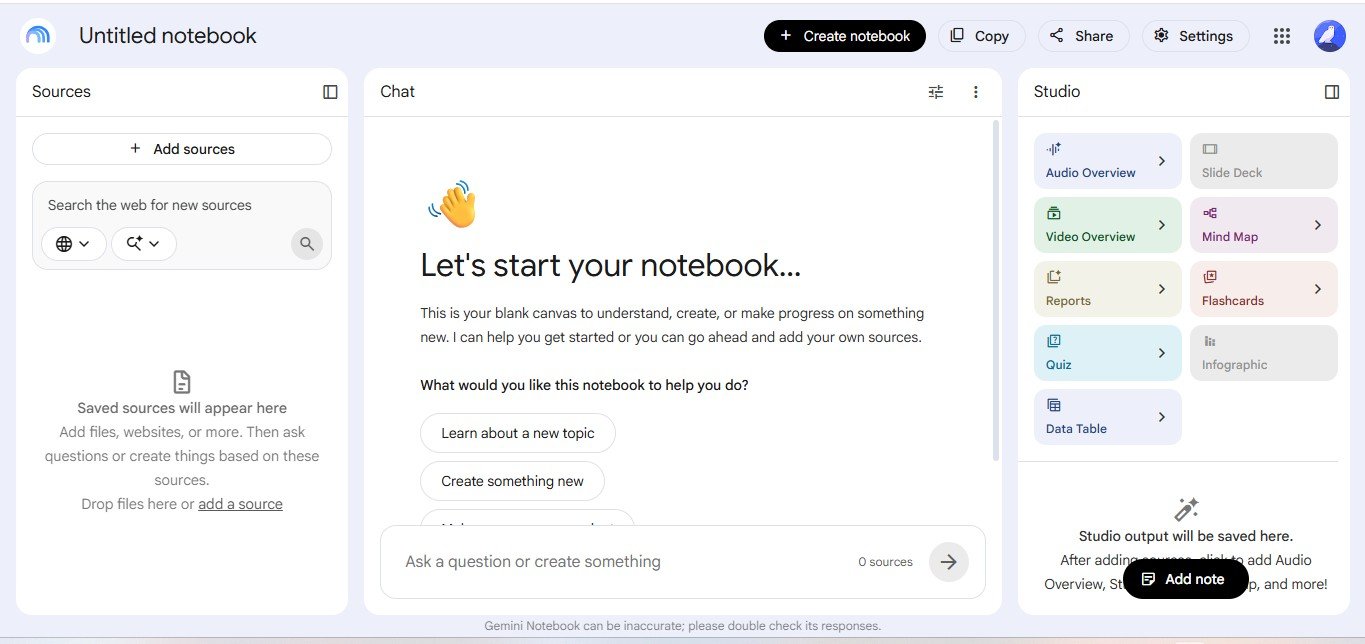
I uploaded the paper into NotebookLM and ran three different tests.
Here’s what happened.
The Research Paper I Used
The paper investigates a pretty interesting question:
Can reading fiction actually change how empathetic we are?
The researchers conducted two experiments.
In the first study, 66 Dutch students were randomly assigned to either a fiction group or a non-fiction control group. The fiction group read an excerpt from Arthur Conan Doyle’s The Adventure of the Six Napoleons.
In the second study, 97 Dutch undergraduate students participated. The fiction group read the first chapter of José Saramago’s Blindness, while the control group read newspaper articles.
The researchers measured empathy at different points in time and also measured emotional transportation—essentially, how emotionally absorbed participants became in what they were reading.
This made the paper a good test case for NotebookLM because it contains:
Research questions
Two separate experiments
Multiple participant groups
Different measurements
Numerical results
Statistical analysis
A delayed follow-up
So instead of asking NotebookLM a simple question, I wanted to see how it handled the paper at different levels.
The research paper I uploaded to NotebookLM for this hands-on test.
Test 1: Can NotebookLM Summarize a Research Paper?
I tested NotebookLM first by asking it to summarize the research paper.
For my first test, I gave NotebookLM this prompt:
Summarize this research paper in simple language. Include the research objective, participants, methodology, main findings, and conclusion. Use only information from the uploaded source.
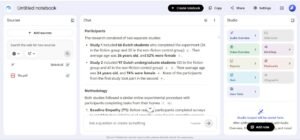
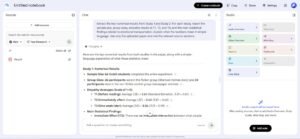
NotebookLM’s first response after I asked it to summarize the research paper.
The result was surprisingly detailed.
NotebookLM identified the main research objective and explained that the researchers wanted to understand whether fiction reading could influence empathy over time and whether emotional transportation affected that relationship.
It also correctly separated the participants from Study 1 and Study 2.
For example, it identified:
Study 1: 66 Dutch students
Study 2: 97 Dutch undergraduate students
It also explained the three measurement points:
T1: Before reading
T2: Immediately after reading
T3: One week later
NotebookLM research paper participants and methodology results
Most importantly, NotebookLM didn’t simply say that fiction “increased empathy.”
It picked up the more complicated finding: the effects depended on emotional transportation and appeared over time rather than immediately.
My verdict on Test 1
Pass.
For a long research paper, the summary was useful because it gave me a structured overview without requiring me to read every section first.
I also liked that NotebookLM provided citations alongside its answers, making it easier to check the information against the original paper.
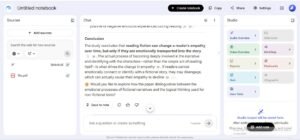
NotebookLM research paper findings and conclusion
Test 2: Can NotebookLM Extract the Research Methodology?
For the second test, I tested NotebookLM on the paper’s detailed methodology. A summary is useful, but I wanted to make the test harder.
I wanted to know whether NotebookLM could find specific methodological details instead of just giving me a general explanation.
So I asked:
Explain the methodology of Study 1 and Study 2 separately. For each study, tell me: (1) number of participants, (2) fiction and control group sizes, (3) what participants read, (4) when empathy was measured, and (5) how the researchers tested whether emotional transportation affected empathy. Use only information from the uploaded paper and cite the relevant source sections.
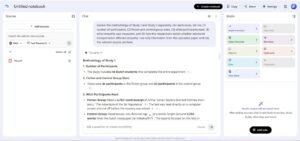
NotebookLM methodology research paper prompt and answer
This time, NotebookLM had to dig deeper into the paper.
And it did a good job.
Study 1
It correctly extracted:
66 participants
36 in the fiction group
30 in the control group
A 2,750-word Sherlock Holmes story for the fiction group
Non-fiction newspaper reports for the control group.
Empathy measured at T1, T2 and T3
Emotional transportation measured after reading
It also used hierarchical regression analysis and examined the interaction between emotional transportation and reading condition.
Study 2
NotebookLM correctly identified:
97 participants
50 fiction participants
47 non-fiction participants
José Saramago’s Blindness for the fiction group
Newspaper articles for the control group
Empathy measured before reading, immediately afterward, and one week later
It also noted that Study 2 included additional controls such as positive and negative emotions, age, gender, narrative experience, narrative understanding, and attentional focus.
NotebookLM research paper methodology and participant details
These details match the original paper.
My verdict on Test 2
Another pass.
This impressed me more than the basic summary.
NotebookLM wasn’t just telling me what the paper was about. It retrieved specific methodological details from different sections and organized them into a much easier format.
Test 3: Can NotebookLM Handle Actual Research Statistics?
For the final test, I tested NotebookLM with the paper’s numerical and statistical results. This was the test I was most interested in.
AI tools can summarize text fairly well. But research papers contain numbers, statistical coefficients, standard deviations, and significance levels.
So I wanted to see whether NotebookLM could extract those details accurately.
I used this prompt:
Extract the key numerical results from Study 1 and Study 2. For each study, report the sample size, group sizes, empathy results at T1, T2, and T3, and the main statistical findings related to emotional transportation. Explain what the numbers mean in simple language. Use only the uploaded paper and cite the relevant source sections.
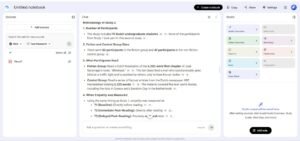
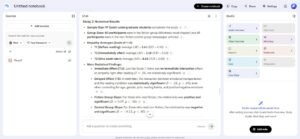
NotebookLM research paper statistics prompt and answer
NotebookLM returned the numerical results for both studies.
For example, for Study 1, it reported the empathy averages as:
T1: M = 3.61
T2: M = 3.54
T3: M = 3.56
It also identified that there was no statistically significant immediate interaction effect after reading.
However, one week later, the interaction between emotional transportation and reading condition became statistically significant.
For Study 2, NotebookLM reported:
T1: M = 3.61
T2: M = 3.58
T3: M = 3.54
NotebookLM research paper numerical and statistical results
Again, the immediate interaction wasn’t statistically significant, while the delayed interaction was significant.
It also extracted the regression coefficients, including the positive relationship for fiction readers and the negative relationship observed for the non-fiction group in Study 2.
My verdict on Test 3
Pass—with one important reminder.
NotebookLM was able to retrieve surprisingly specific statistical information from the paper.
But I wouldn’t treat that as a reason to stop checking the original research.
When you’re dealing with statistics, always verify important numbers against the original paper.
NotebookLM is useful for finding and explaining information. It shouldn’t replace the source.
[Insert your Test 3 screenshots here]
What I Learned From Testing NotebookLM
After running all three tests, I noticed something important.
NotebookLM was most useful when I gave it specific questions.
My first prompt asked for a general summary.
The second asked it to extract particular methodological details.
The third asked it to find specific numerical results.
The more specific my question became, the more targeted the answer became.
This is something I would keep in mind if you’re planning to use NotebookLM for academic research.
If you’re comparing AI tools for academic work, you may also want to read my guide to the best LLMs for research papers.
Instead of asking:
“Tell me about this paper.”
Try asking:
“What were the participant groups in Study 1?”
Or:
“What statistical method did the researchers use?”
Or:
“What happened to empathy one week after reading?”
Specific questions produce much more useful answers.
What I Liked About NotebookLM
1. It worked directly with the uploaded source
I didn’t have to manually copy and paste sections of the paper into a chatbot.
I uploaded the research paper and asked questions about it.
2. It handled long and detailed information well
The paper contained two experiments, multiple groups, different measurements, and statistical analyses.
NotebookLM was able to organize those details into readable answers.
3. The citations were useful
The answers included citations pointing back to the source.
That made fact-checking much easier.
4. It could extract numbers, not just general ideas
This was probably my favorite part of the test.
It wasn’t limited to saying “the researchers found that fiction may influence empathy.”
It could retrieve participant numbers, means, standard deviations, and statistical findings.
5. It made a complicated research paper easier to navigate
I still had the original paper available, but NotebookLM helped me locate the information I wanted much faster.
What I Didn’t Like
The experience wasn’t perfect.
It doesn’t mean you can stop reading the original paper.
This is probably the biggest limitation.
If you’re doing serious academic work, you shouldn’t blindly copy an AI-generated explanation into your research.
Even when an answer looks correct, important details should be checked against the source.
The quality of the answer depends on your prompt.
A vague question gives you a broad answer.
A carefully written question gives you a much more useful answer.
So learning how to ask specific questions is still important.
Statistics require extra caution.
NotebookLM successfully extracted the statistics I asked for, but statistical interpretation is more sensitive than ordinary summarization.
For important research work, I would still open the original tables and results section.
My Final Verdict: Is NotebookLM Useful for Research Papers?
After I Tested NotebookLM across these three tasks, I found it useful as a research-reading assistant.
What impressed me wasn’t that it could summarize a PDF.
Most modern AI tools can do that.
What I found more useful was its ability to move from a general summary to specific methodological details and then to numerical results.
In my test, NotebookLM successfully helped me answer three different questions:
What is this paper about?
How was the research conducted?
What did the numbers actually show?
The original research itself found that fiction reading’s effect on empathy appeared over time and was related to how emotionally transported readers became into the story.
And NotebookLM was able to surface those findings from the paper in a much more accessible way.
My overall rating after this test: 8.5/10
I wouldn’t use NotebookLM as a replacement for reading academic papers.
I’d use it as a research companion—something that helps me understand, navigate, and question a paper faster.
Who Should Try NotebookLM?
I think NotebookLM could be especially useful for:
🎓 Students reading research papers
🔬 Research students
📚 People reviewing academic literature
👩💻 Professionals working with technical documents
📝 Writers researching a topic
📖 Anyone who struggles with long PDFs
If you’re regularly dealing with long documents, the ability to ask questions directly about your uploaded sources can save a lot of time.
Jms Smrity is an AI enthusiast and the creator of ToolFluxAI. She writes about AI tools, content creation software, and emerging technology to help readers make informed decisions and stay updated with the latest innovations in artificial intelligence.
I am the creator and writer behind ToolFlux AI, a platform dedicated to sharing valuable content about Artificial Intelligence, AI tools, blogging, SEO, automation, and digital productivity.