Natural language processing has become one of the most important areas of artificial intelligence. Every time you use a search engine, ask a chatbot a question, translate a sentence, or interact with an AI assistant, you’re using technology built around language understanding and generation.
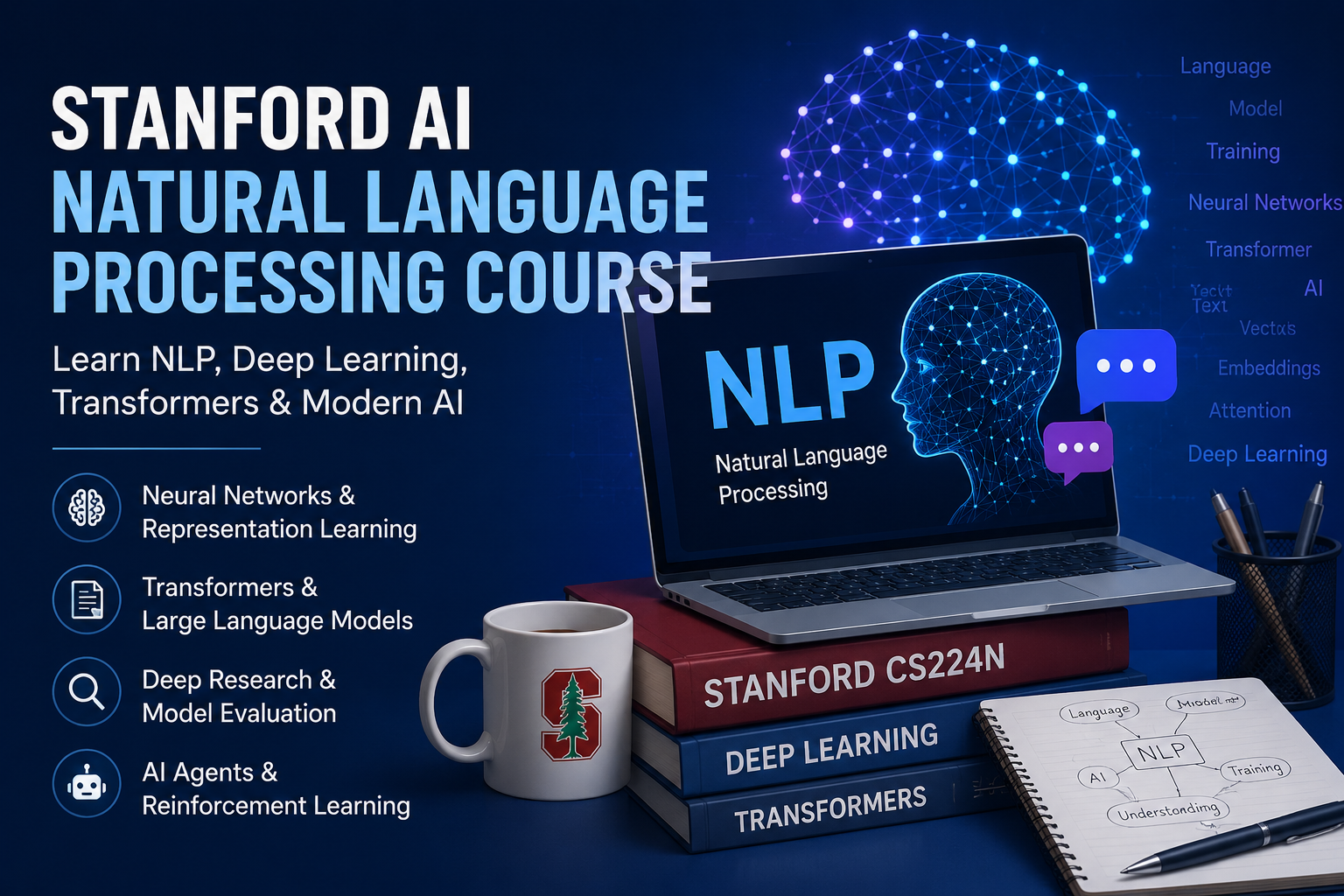
If you want to study NLP beyond basic tutorials, Stanford’s CS224N: Natural Language Processing with Deep Learning is a course worth exploring.
The course goes beyond explaining what NLP is. It connects language processing with neural networks, representation learning, Transformers, large language models, and modern AI research. Stanford’s recent CS224N materials also cover prompting, reinforcement learning from human feedback, model evaluation, training, and AI agents.
This guide explains what the Stanford AI natural language processing course is, what you’ll learn, what you need before starting, how to access available resources, and how to turn the course material into practical NLP skills.
What Is the Stanford AI Natural Language Processing Course?
When people search for a Stanford AI natural language processing course, they’re often referring to CS224N: Natural Language Processing with Deep Learning.
CS224N is a Stanford course focused on the use of deep learning techniques for processing and understanding human language. The course combines foundational NLP concepts with neural network methods and modern language-model research.
Stanford describes NLP as an important part of artificial intelligence because so much human communication happens through language. NLP is used in applications ranging from search and translation to customer service, virtual agents, and other language-based systems.
What makes CS224N particularly interesting today is its connection to the technology behind modern language models. The course has evolved alongside NLP research, moving from earlier deep-learning approaches toward topics surrounding Transformers and large language models.
In other words, this isn’t simply a course about tokenizing text or building a basic sentiment classifier. It is designed to help learners understand how modern neural NLP systems work.
What Is Stanford CS224N?
CS224N stands for Natural Language Processing with Deep Learning.
The course is designed around three things:
- Understanding how language can be represented computationally
- Learning how neural networks can process language
- Understanding modern NLP research and language-model techniques
The course includes lectures, programming assignments, and project-based work. Stanford’s recent course materials describe the goal as developing the skills needed to design, implement, and understand neural network models using PyTorch.
The course has also changed over time. Earlier versions focused heavily on deep learning approaches for NLP, while newer materials incorporate the rapid development of Transformers, pretraining, and large language models.
That evolution is one reason CS224N remains relevant to people interested in modern AI.
What Will You Learn in the Stanford NLP Course?
The exact topics can vary between course offerings, but the publicly available Stanford materials show a broad progression from NLP foundations to modern AI techniques.
1. Word Representations and Word Vectors
One of the foundational ideas in NLP is representing words numerically.
Computers don’t naturally understand words in the same way humans do. NLP models therefore need numerical representations that capture useful information about language.
CS224N materials introduce concepts such as word vectors and distributed representations. These ideas provide an important foundation for understanding how later neural language models work.
2. Neural Networks for NLP
After learning about representations, the course moves into neural network methods.
You’ll encounter concepts such as:
- Neural network architectures
- Forward propagation
- Backpropagation
- Loss functions
- Optimization
- Tensor operations
- Model training
This section is particularly useful because NLP isn’t just about linguistic concepts. You also need to understand how the underlying machine-learning systems learn from data.
3. Dependency Parsing
Parsing is another important part of NLP.
A sentence isn’t simply a collection of independent words. The relationships between words can carry important information about meaning.
Dependency parsing attempts to represent these relationships and helps learners understand how computational systems can analyze sentence structure.
4. Recurrent Neural Networks
Before Transformers became dominant, recurrent architectures played a major role in neural NLP.
RNN-based models process sequences while maintaining information about earlier parts of the input. Studying them is still valuable because it helps explain the problems that later architectures were designed to solve.
Understanding this progression can make the transition to attention and Transformers much easier.
5. Attention and Transformers
This is where NLP becomes particularly relevant to today’s AI landscape.
Transformers changed how many language-processing systems are designed. Instead of processing language only through sequential recurrence, attention mechanisms allow models to consider relationships between different parts of an input.
Stanford’s CS224N materials include dedicated lectures on Transformers and later topics built around modern language-model approaches.
If you’re interested in ChatGPT-style systems, LLM applications, or generative AI, this part of the course is especially important.
6. Pretraining and Large Language Models
Modern NLP increasingly relies on pretrained models.
Instead of training a model from scratch for every individual task, large models can first learn general language patterns from massive datasets and then be adapted to particular applications.
Stanford’s course materials have expanded to include modern topics around pretraining and large language models. The Winter 2025 course description, for example, explicitly connects deep-learning foundations with recent LLM research.
7. Prompting, Evaluation, and Modern LLM Techniques
NLP education has changed significantly because of large language models.
Stanford’s publicly available lecture index includes topics such as prompting, RLHF, evaluation, model training, agents, and deployment.
These topics help bridge the gap between traditional NLP coursework and the AI systems people are building today.
Is the Stanford NLP Course Free?
This question needs a little clarification.
You can access a substantial amount of Stanford CS224N educational material online, including publicly available lecture videos from previous offerings, lecture slides, and assignments.
Stanford’s archived course pages explicitly state that complete videos from the 2023 version are available for free through the CS224N YouTube playlist. The same pages also explain that course materials such as slides and assignments are updated as the course progresses.
However, there is an important distinction between studying publicly available materials and enrolling as a Stanford student.
You don’t need to be a Stanford student simply to learn from publicly available course resources. But watching online lectures does not mean you’re enrolled in Stanford’s academic course or earning Stanford academic credit.
Stanford also offers an XCS224N version through its Artificial Intelligence Professional Program, which is a separate paid option.
So, if your goal is self-study, you can make substantial progress using the publicly available resources without enrolling in the university course.
Where Can You Find Stanford NLP Course Materials?
The best place to start is Stanford’s official CS224N website and its associated course resources.
Public materials can include:
- Lecture slides
- Lecture videos from selected offerings
- Assignments
- Assignment code
- Reading recommendations
- Project information
- Archived course websites
Stanford’s current materials also maintain a large collection of lecture slides. The official slide directory includes topics ranging from word vectors and neural networks to Transformers, pretraining, prompting, RLHF, evaluation, agents, and deployment.
What Are the Prerequisites for CS224N?
CS224N isn’t really designed as a first-ever programming or AI course.
You don’t need to be an expert in machine learning before opening the lectures, but having some technical background will make the material much easier to follow.
Python
Python is particularly important.
Stanford’s course assignments use Python, with tools including NumPy and PyTorch.
You should be comfortable with:
- Variables and data types
- Functions
- Loops
- Lists and dictionaries
- Classes and objects
- Basic file handling
- Installing and using Python libraries
Mathematics
A basic understanding of mathematics will also help.
You should ideally know:
- Linear algebra
- Probability
- Basic calculus
- Derivatives
- Optimization concepts
You don’t need to become a mathematician before starting. The important thing is understanding the mathematical ideas behind model training.
Machine Learning
A beginner-friendly preparation list would include:
- Supervised learning
- Training and validation
- Loss functions
- Gradient descent
- Overfitting
- Neural networks
If these terms are completely unfamiliar, it may be better to spend some time learning introductory machine learning first.
Do You Need PyTorch?
If you want to do the practical side of the Stanford NLP course, learning PyTorch is highly recommended.
Stanford’s course materials use PyTorch for implementing neural NLP models.
You don’t have to master every part of PyTorch before beginning.
Start with:
- Tensors
- Tensor operations
- Datasets and data loaders
- Neural network modules
- Loss functions
- Optimizers
- Training loops
Once you understand those basics, the assignments become much less intimidating.
Is Stanford CS224N Suitable for Beginners?
It depends on what you mean by beginner.
If you’re completely new to programming, machine learning, and AI, jumping directly into CS224N will probably feel overwhelming.
But if you already know Python and have some exposure to machine learning, you can gradually work your way through it.
A good preparation sequence is:
Python → Machine Learning → Neural Networks → Basic NLP → PyTorch → CS224N
This approach is much more realistic than trying to understand everything in the first lecture.
Don’t worry if some of the mathematics or research terminology looks unfamiliar at first. Advanced technical courses often become easier after you’ve built the necessary foundation.
If you’re completely new to AI, start with foundational material first and return to CS224N when you’re ready.
How to Study the Stanford AI Natural Language Processing Course
Watching every lecture isn’t enough.
NLP is one of those areas where the difference between recognizing a concept and actually understanding it can be huge.
Start With the Fundamentals
Don’t skip word vectors, neural networks, or basic language modeling just because Transformers and LLMs sound more interesting.
The earlier concepts explain why later architectures were developed.
Code Along With the Course
Whenever you learn a concept, try implementing a simplified version.
For example, after learning about:
- Word embeddings → experiment with word vectors.
- Classification → build a small text classifier.
- Attention → implement a simplified attention mechanism
- Transformers → use a pretrained Transformer for a practical task.
You will remember considerably more from building something than from watching another hour of lectures.
Read the Papers
CS224N is also useful for learners who want to move toward AI research.
You don’t need to understand every equation in a research paper on the first reading.
Instead:
- Read the abstract.
- Understand the problem.
- Identify the proposed approach.
- Look at the main results.
- Return to the technical details.
Over time, you’ll become more comfortable with research literature.
What Projects Can You Build After Learning NLP?
A project is one of the best ways to turn course knowledge into practical experience.
Beginner NLP Projects
Try:
- Sentiment analysis
- Spam detection
- News classification
- Simple text categorization
Intermediate Projects
Once you’re comfortable with neural NLP, move toward:
- Named entity recognition
- Question answering
- Text summarization
- Semantic search
- Document classification
Advanced Projects
For learners interested in modern AI, consider:
- Transformer-based text classification
- Retrieval-augmented generation
- Domain-specific question answering
- LLM evaluation
- Fine-tuning experiments
- AI research assistants
Stanford’s recent CS224N project reports show how advanced student projects can explore areas such as efficient attention, speculative decoding, and fine-tuning.
You don’t need to start at that level. A small, well-documented NLP project is much better than an unfinished attempt at building a giant language model.
Stanford NLP Course Study Roadmap
If you’re studying independently, here’s a practical eight-week roadmap.
Week 1: NLP Foundations
Learn:
- NLP basics
- Word representations
- Word vectors
- Language modeling
Focus on understanding the concepts rather than rushing through the lectures.
Week 2: Neural Network Foundations
Review:
- Neural networks
- Backpropagation
- Optimization
- Tensor operations
Practice with small Python/PyTorch examples.
Week 3: Sequence Models
Study:
- RNNs
- Language models
- Sequence-to-sequence architectures
Try building a small sequence-processing project.
Week 4: Attention
Learn why attention became important and how it addresses limitations of earlier sequence models.
Week 5: Transformers
Spend extra time here.
Understand:
- Self-attention
- Multi-head attention
- Positional information
- Encoder/decoder concepts
- Transformer architecture
Week 6: Pretraining and LLMs
Study:
- Pretrained models
- Fine-tuning
- Self-supervised learning
- Large language models
Week 7: Modern NLP
Explore:
- Prompting
- Evaluation
- Alignment techniques
- Agents
- Efficient model deployment
Stanford’s recent lecture materials include several of these modern topics.
Week 8: Build Something
Choose one project and apply what you’ve learned.
Don’t worry about creating the next ChatGPT.
A focused project that demonstrates your understanding of NLP is enough.
Stanford NLP Course vs Learning NLP From YouTube Tutorials
YouTube tutorials can be useful, especially when you’re trying to understand one specific concept.
But a structured university-level course offers something different.
With random tutorials, you may learn:
“Here’s how to use this model.”
With a deeper course, you’re encouraged to understand:
“Why does this model work, and what happens underneath it?”
That’s an important difference if your goal is research, machine learning engineering, or advanced AI development.
A combination of both can actually work well: use CS224N as the main curriculum and simpler tutorials whenever you get stuck on a difficult concept.
Who Should Take the Stanford NLP Course?
CS224N is particularly valuable for:
- Computer science students
- AI and machine learning students
- Software developers moving into AI.
- NLP enthusiasts
- Researchers
- Students interested in LLMs
- Anyone who wants deeper technical knowledge of language models
It’s less suitable as a first introduction to programming.
If you’re completely new to AI, start with foundational material first and return to CS224N when you’re ready.
If you’re a student exploring AI tools alongside your coursework,
Common Challenges You’ll Face
The Mathematics Can Feel Difficult
Don’t try to memorize equations.
Instead, understand what each equation is trying to accomplish.
The Research Papers Are Dense
That’s normal.
Read them several times and don’t expect complete understanding on the first pass.
The Assignments Can Take Time
Stanford’s assignments are designed to develop both theoretical and practical understanding. Recent course materials include programming components involving word vectors, neural-network foundations, machine translation, attention, and Transformer-based methods.
Give yourself enough time rather than trying to finish everything in one sitting.
Modern NLP Changes Quickly
NLP is moving rapidly because of LLM research.
Some details you learn today may change, but the fundamental concepts—representation learning, optimization, attention, evaluation, and model architecture—remain useful.
Is Stanford CS224N Worth Learning in 2026?
Yes, particularly if you want to understand what’s happening underneath modern language-model systems.
The biggest advantage isn’t simply having “Stanford” on your learning list.
It’s the depth of the material.
A good NLP learner should eventually be able to move beyond using an AI model through an API and understand concepts such as representations, attention, training, evaluation, and model adaptation.
CS224N can help build that foundation.
At the same time, don’t treat it as a shortcut to becoming an AI engineer. You still need programming practice, machine-learning fundamentals, projects, and experience working with real datasets.
Final Thoughts
The Stanford AI natural language processing course is a strong option for learners who want to go deeper into NLP and modern language models.
CS224N connects foundational NLP concepts with deep learning and newer developments in the field. Its publicly available resources also make it possible for independent learners to explore Stanford-level material without necessarily enrolling as a Stanford student.
If you’re new to AI, don’t feel pressured to start with the hardest material immediately. Build your Python and machine-learning foundations first, then work through the Stanford lectures gradually.
And once you’ve learned a concept, build something with it.
That’s where the course stops being just another collection of lectures and starts becoming a useful part of your AI skill set.
If you’re exploring AI beyond NLP,
Our AI tools for students resources can also help you discover practical tools for learning, research, and productivity.
Frequently Asked Questions
Is the Stanford AI natural language processing course free?
Some CS224N materials, including publicly available lecture videos from previous offerings, slides, and assignments, can be accessed online for free. However, publicly available materials are different from enrolling in Stanford’s academic course.
What is Stanford CS224N?
CS224N is Stanford’s Natural Language Processing with Deep Learning course. It covers neural approaches to NLP and modern topics related to language models and LLMs.
Do I need Python for CS224N?
Yes. Python is important for the practical coursework, and Stanford’s assignments use Python with tools such as NumPy and PyTorch.
Can beginners learn Stanford NLP?
Yes, but complete beginners should prepare first. Python, basic machine learning, neural networks, and some mathematics will make the course much easier to follow.
Can I learn Stanford CS224N without being a Stanford student?
Yes, you can study publicly available course materials without being enrolled at Stanford. However, accessing public materials is not the same as taking the university course for academic credit.
Does CS224N cover large language models?
Modern versions of the course include material related to large language models and contemporary NLP research. Stanford’s recent materials also include topics such as pretraining, prompting, evaluation, and other LLM-related techniques.
Is CS224N useful for learning about ChatGPT and LLMs?
Yes. It won’t teach you everything required to build a system like ChatGPT from scratch, but it can give you a much deeper understanding of the NLP and deep-learning concepts behind modern language models.
How long does it take to learn CS224N?
There isn’t a fixed answer. A learner with a strong Python and machine-learning background can move much faster than someone starting from scratch. For self-study, an eight-week roadmap is a reasonable starting point, but complex assignments and research topics may require additional time.
About The Author
Jms Smrity is an AI enthusiast and the creator of ToolFluxAI. She writes about AI tools, content creation software, and emerging technology to help readers make informed decisions and stay updated with the latest innovations in artificial intelligence.