

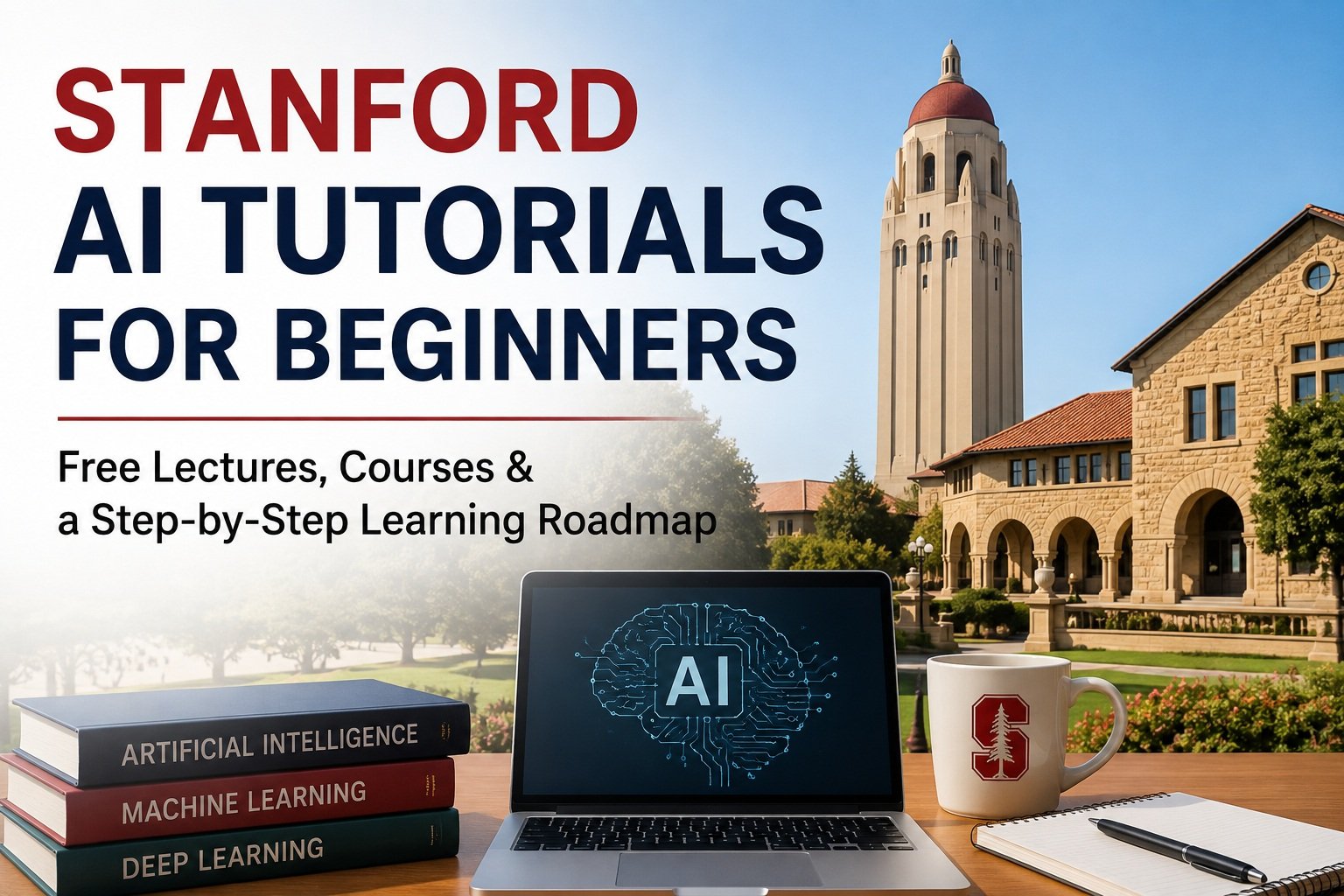
Stanford AI tutorials for beginners can be a great way to explore artificial intelligence from one of the world’s best-known academic institutions. But there is a catch: Stanford has a huge amount of AI-related material, and not all of it is designed for someone who is completely new to the field.
You might find a machine learning lecture that looks interesting, only to discover that it assumes you already know Python, probability, or linear algebra. Another course may sound beginner-friendly but quickly move into mathematical concepts that are difficult to follow without preparation.
That’s why choosing the right starting point matters.
Stanford offers resources covering artificial intelligence, machine learning, deep learning, natural language processing, reinforcement learning, and other areas of AI. The Stanford AI Lab also provides introductions to several Stanford AI courses, including CS221, CS229, CS230, CS224N, and CS234.
In this guide, we’ll look at some of the most useful Stanford AI learning resources for beginners, explain what background you may need, and build a practical roadmap you can follow without trying to study everything at once.
If you’re also looking for practical AI resources for education, check out our guide to Best AI Tools for Students.
What Are Stanford AI Tutorials for Beginners?
The phrase Stanford AI tutorials for beginners doesn’t refer to one specific Stanford course.
Instead, it can describe the collection of Stanford lectures, course materials, educational videos, notes, assignments, and introductory resources that people can use to learn about artificial intelligence.
Stanford’s AI-related courses cover a surprisingly wide range of subjects. Depending on your interests, you can explore:
- Artificial intelligence
- Machine learning
- Deep learning
- Natural language processing
- Reinforcement learning
- Computer vision
- Probabilistic models
- Generative models
- Robotics
- Machine learning with graphs
That variety is one of Stanford’s biggest advantages, but it can also make the learning process confusing.
A beginner doesn’t need to study every one of these subjects.
The smarter approach is to build a foundation first and then choose the area that interests you most.
Are Stanford AI Tutorials Good for Beginners?
Yes, but not every Stanford AI resource is beginner-friendly.
This is probably the most important thing to understand before you start.
Stanford’s AI courses are generally university-level resources. Some are accessible to learners with a basic technical background, while others expect students to already understand programming, mathematics, statistics, or computer science.
For example, Stanford’s CS229 Machine Learning course expects students to have experience with programming and knowledge of probability, linear algebra, and multivariable calculus.
That doesn’t mean beginners should avoid Stanford.
It simply means you should choose the right starting point.
If you’ve never written code before, spend some time learning Python first. If machine learning mathematics looks unfamiliar, review basic statistics and linear algebra before diving into the most technical lectures.
A little preparation can make a difficult course much easier to understand.
Best Stanford AI Tutorials for Beginners to Explore
There isn’t one perfect course for everyone. Your ideal starting point depends on your background and what you want to do with AI.
Here are several Stanford resources worth exploring as you build your knowledge.
1. Stanford AI Course Introductions
If you’re not sure which area of AI interests you yet, start broad.
Stanford’s AI Lab provides introductions to several Stanford AI courses. These introductions can help you understand what different courses cover before you decide where to spend your time.
For example, you might discover that machine learning interests you more than robotics, or that natural language processing is more relevant to your goals than reinforcement learning.
That can save you from spending weeks studying a subject you don’t actually enjoy.
Best for: Beginners who are still deciding which AI field to explore.
2. Stanford CS221: Artificial Intelligence
If you want to understand AI as a broader field rather than focusing only on machine learning, CS221 is an interesting option.
The course introduces concepts related to search, decision-making, logic, machine learning, graphical models, and other areas of artificial intelligence.
It can help you understand that AI is much bigger than neural networks and chatbots.
However, CS221 is still a technical university course. Stanford lists programming, discrete mathematics, probability, and algorithms among the expected background.
So I wouldn’t recommend it as the very first resource for someone who has never studied computer science.
Instead, think of CS221 as a course you can work toward after building some basic programming and mathematical knowledge.
Best for: Learners who want a broad understanding of artificial intelligence.
You can learn more about the course through Stanford’s official CS221 page.
3. Stanford CS229: Machine Learning
For many AI learners, CS229 is one of the most attractive Stanford courses.
It focuses specifically on machine learning and covers a broad selection of topics, including supervised learning, unsupervised learning, neural networks, support vector machines, clustering, dimensionality reduction, and reinforcement learning.
Stanford Engineering Everywhere provides publicly accessible CS229 course materials, including lectures, handouts, transcripts, and assignments. You can explore the publicly available materials through Stanford Engineering Everywhere’s CS229 course.
That makes the resource particularly useful for independent learners.
But there’s an important warning for beginners.
CS229 is not a zero-to-AI course.
If terms such as gradient descent, probability distributions, vectors, matrices, or regression are completely unfamiliar, you may find the lectures difficult.
Before starting the full course, try to become comfortable with Python and basic mathematics.
Once you have that foundation, CS229 can become a much more valuable learning resource.
Best for: Learners with some programming and mathematics experience who want to study machine learning seriously.
4. Stanford CS230: Deep Learning
Deep learning is behind many modern AI applications, from computer vision systems to language technologies.
Stanford’s CS230 focuses on deep learning and is a natural direction for learners who already understand some machine learning concepts.
Topics in this area can include:
- Neural networks
- Backpropagation
- Optimization
- Convolutional neural networks
- Representation learning
- Deep learning applications
If you’re completely new to AI, don’t worry if this material looks too advanced at first.
Deep learning becomes much easier to understand once you know what a model is, how training works, what a loss function does, and why models can overfit.
Best for: Learners who have already developed a foundation in machine learning.
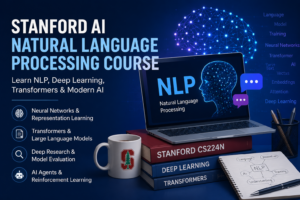
5. Stanford CS224N: Natural Language Processing
If your interest in AI started with ChatGPT, chatbots, translation tools, or other language-based applications, NLP may be the area that interests you most.
Stanford’s CS224N focuses on Natural Language Processing with Deep Learning.
The subject involves teaching computers to work with human language and includes areas such as language representation, text processing, language models, machine translation, and neural approaches to NLP.
You don’t necessarily need to become an NLP expert before exploring the subject.
However, having some Python and machine learning knowledge will make the material considerably easier to follow.
Best for: Learners interested in language models, chatbots, text analysis, and conversational AI.
6. Stanford CS234: Reinforcement Learning
Reinforcement learning is different from the machine learning problems many beginners first encounter.
Instead of simply learning from a fixed dataset, reinforcement learning involves an agent interacting with an environment and learning which actions lead to better outcomes.
This idea has applications in:
- Robotics
- Games
- Autonomous systems
- Decision-making
- Control problems
Stanford’s CS234 is aimed at learners who already have some technical preparation, so it is better viewed as a later step rather than your first AI tutorial.
Best for: Intermediate learners interested in decision-making and autonomous systems.
Are Stanford AI Courses Free?
This is one area where you should be careful with the wording.
Some Stanford lectures and course materials are publicly available online. Stanford Engineering Everywhere, for example, provides CS229 materials that can be accessed for self-study.
However, not every Stanford AI course or program is free.
Stanford also offers professional education and other programs that may require payment or enrollment.
So if you’re writing about a particular Stanford course, check the official Stanford page before describing it as free.
For ToolFluxAI, a safer approach is to use phrases such as:
“free Stanford AI lectures and publicly available course materials”
rather than suggesting that every Stanford AI course is completely free.
What Should Beginners Learn Before Stanford AI Tutorials?
You don’t need to spend years preparing before you start.
A few basic skills can make a huge difference.
Learn Python First
Python is widely used in machine learning and AI.
You don’t need advanced programming skills at the beginning.
Focus on:
- Variables
- Data types
- Conditions
- Loops
- Functions
- Lists
- Dictionaries
- Basic file handling
- NumPy
- Pandas
- Simple data visualization
The goal isn’t to memorize every Python feature.
You want to become comfortable enough with code that programming itself doesn’t distract you from learning AI.
Build a Basic Mathematics Foundation
Mathematics can look intimidating when you’re new to AI, but you don’t need to master everything immediately.
Start with:
- Algebra
- Probability
- Statistics
- Vectors
- Matrices
- Basic calculus
Linear algebra becomes especially useful when you start working with vectors, matrices, and neural networks.
Probability and statistics help you understand uncertainty, data, and model evaluation.
As you move toward more advanced machine learning, these topics become increasingly important.
Understand Basic Machine Learning Concepts
Before starting a technical Stanford machine learning course, make sure you understand the meaning of common terms such as:
- Dataset
- Feature
- Label
- Model
- Training
- Testing
- Prediction
- Classification
- Regression
- Overfitting
You don’t need to know the mathematics behind every algorithm yet.
First, understand the intuition.
Once the basic ideas are clear, the technical material becomes much easier to follow.
A Step-by-Step Stanford AI Learning Roadmap
If you’re starting from a beginner level, don’t try to jump directly into the hardest Stanford course.
Instead, follow a gradual progression.
Step 1: Understand the AI Basics
Begin by learning the difference between:
Artificial Intelligence → Machine Learning → Deep Learning → Generative AI
Understanding these relationships gives you a mental map of the field.
At this stage, focus on concepts rather than formulas.
Step 2: Learn Python
Spend a few weeks practicing Python.
Write small programs.
Work with simple datasets.
Try basic calculations and visualizations.
The more comfortable you become with programming, the less intimidating AI tutorials will feel.
Step 3: Study Basic Mathematics
Learn probability, statistics, linear algebra, and the most relevant calculus concepts.
You don’t have to study them all before touching machine learning.
It’s perfectly fine to learn mathematics alongside your AI studies.
Step 4: Learn Machine Learning Fundamentals
Before moving into Stanford’s more technical material, understand:
- Regression
- Classification
- Clustering
- Training and testing
- Model evaluation
- Overfitting
- Basic optimization
At this point, you’ll have enough context to understand what many machine learning lectures are actually trying to teach.
Before choosing an AI course, beginners may also want to explore our guide to Best AI Tools for Beginners
Step 5: Explore Stanford CS229
Once you have the basics, start exploring CS229.
Don’t rush through every lecture.
Watch one topic, take notes, and try to implement or practice what you learned.
Stanford Engineering Everywhere provides a collection of CS229 lectures and supporting course material that can be useful for self-study.
Step 6: Choose Your AI Specialization
After getting comfortable with machine learning, choose one direction.
Interested in language?
Explore NLP.
Interested in neural networks?
Explore deep learning.
Interested in autonomous decision-making?
Explore reinforcement learning.
Interested in broader AI concepts?
Explore artificial intelligence and related CS courses.
You don’t need to learn everything.
Specializing in one area can actually make your learning journey easier.
Step 7: Build a Small AI Project
This is the step many beginners skip.
Don’t spend six months watching lectures without building anything.
Once you understand the basics, try a small project.
For example:
- Spam email classifier
- Sentiment analysis tool
- House price prediction model
- Simple recommendation system
- Student performance predictor
- Basic image classifier
Your first project doesn’t need to be impressive.
It just needs to make you use what you’ve learned.
How to Study Stanford AI Tutorials Effectively
A common problem with online learning is passive consumption.
You watch a lecture, understand most of it, and then move on.
A few days later, you realize that you can’t explain the concept anymore.
A better approach is:
Watch → Understand → Practice → Review
When you finish a lecture, write down the main idea in your own words.
Then ask yourself:
“Could I explain this concept to someone who has never studied AI?”
If the answer is no, revisit the difficult part.
If the lecture includes an algorithm or mathematical idea, try implementing a simple version in Python.
You don’t need to reproduce an entire research system.
Even a small experiment can turn an abstract concept into something concrete.
Stanford AI Tutorials vs Beginner YouTube Tutorials
You don’t have to choose between Stanford and beginner-friendly online tutorials.
Both can serve different purposes.
| Feature | Stanford Resources | Beginner YouTube Tutorials |
|---|---|---|
| Academic depth | Usually high | Varies |
| Beginner explanations | Varies | Often strong |
| Mathematical detail | Often high | Varies |
| Structured learning | Course-dependent | Varies |
| Practical demonstrations | Varies | Often available |
| University-level topics | Strong | Depends on creator |
A practical strategy is to use beginner tutorials when a concept is confusing and Stanford material when you want to explore it more deeply.
For example, you might first learn the intuition behind gradient descent from a beginner tutorial and then study how Stanford explains the underlying mathematics.
There’s nothing wrong with using multiple resources.
Can You Learn AI From Stanford Without a Computer Science Degree?
Yes.
A computer science degree can make the process more structured, but it isn’t a requirement for learning AI independently.
The bigger issue is background knowledge.
A learner without a CS degree may simply need to spend more time building skills in Python, mathematics, statistics, and algorithms.
That’s completely normal.
You can create your own learning sequence:
Python → Mathematics → Machine Learning → Stanford Courses → Projects
The important part is consistency.
Can You Learn AI Without Programming?
You can learn about AI without programming.
For example, you can understand:
- What machine learning is
- How neural networks work conceptually
- What generative AI means
- How AI is used in different industries
But if your goal is to build AI applications, analyze datasets, or train models, programming will eventually become necessary.
That’s why learning Python early is useful.
You don’t have to become a professional software engineer.
You simply need enough programming knowledge to experiment and build.
Common Mistakes Beginners Make
Starting With the Hardest Stanford Course
A famous course isn’t necessarily the best first course.
If you’re missing the prerequisites, you’ll spend more time fighting the material than learning from it.
Trying to Learn Every AI Field
AI is too broad to master everything simultaneously.
Choose a direction and explore it properly.
Ignoring Mathematics Completely
You don’t need advanced mathematics immediately, but avoiding it forever will make technical machine learning increasingly difficult.
Watching Lectures Without Practicing
A lecture can explain an idea.
Practice is what helps you remember it.
Focusing Only on Certificates
A certificate can be useful in some situations, but your actual understanding and projects matter too.
Try to build something rather than simply collecting course completions.
Using AI to Skip the Learning Process
AI assistants can be useful for explaining difficult concepts, generating practice questions, or helping you debug code.
But don’t let an AI tool do all the thinking for you.
The goal is to become capable of solving problems yourself.
What Can You Build After Learning the Basics?
Once you have basic Python and machine learning knowledge, you can start experimenting with small projects.
Beginner Projects
Spam Classifier
Train a simple model to identify spam and non-spam messages.
Sentiment Analyzer
Analyze whether a piece of text expresses a positive or negative sentiment.
House Price Predictor
Use a dataset to predict house prices based on selected features.
Recommendation System
Build a basic system that recommends movies, books, or other items.
Image Classifier
Train a simple model to distinguish between different image categories.
The purpose of these projects isn’t to create the next ChatGPT.
It’s to learn how the pieces fit together.
A 12-Week Learning Plan for Beginners
If you want a simple schedule, here’s one possible approach.
Weeks 1–2: AI Fundamentals
Learn:
- What AI means
- What machine learning means
- What deep learning means
- What generative AI means
- Common AI applications
Weeks 3–4: Python
Practice:
- Python basics
- Functions
- Lists and dictionaries
- NumPy
- Pandas
- Basic visualization
Weeks 5–6: Mathematics
Focus on:
- Probability
- Statistics
- Vectors
- Matrices
- Basic calculus
Weeks 7–8: Machine Learning
Learn:
- Regression
- Classification
- Clustering
- Training and testing
- Overfitting
- Model evaluation
Weeks 9–10: Stanford AI Resources
Start exploring Stanford lectures and course materials that match your background.
If you already have the required foundation, this is a good point to explore CS229.
Week 11: Choose a Specialization
Pick one area:
- Deep learning
- NLP
- Reinforcement learning
- Computer vision
- General AI
Week 12: Build a Project
Choose one small project and apply what you’ve learned.
Don’t worry about making it perfect.
The goal is to finish something.
Which Stanford AI Course Should Beginners Start With?
There isn’t a universal answer.
Your starting point should depend on your current skills.
| Your Background | Suggested Direction |
|---|---|
| Completely new to AI | AI fundamentals first |
| No programming experience | Python + AI basics |
| Basic Python | Machine learning fundamentals |
| Python + basic mathematics | Explore CS229 |
| Strong computer science background | Explore CS221 |
| Machine learning experience | CS230, CS224N, or CS234 |
| Interested in language AI | CS224N |
| Interested in deep learning | CS230 |
| Interested in decision-making | CS234 |
The important thing is to match the course with your current level rather than choosing a course simply because it has a prestigious name.
Frequently Asked Questions About Stanford AI Tutorials for Beginners
Are Stanford AI tutorials free?
Some Stanford AI lectures and course materials are publicly available online. However, Stanford also offers paid courses and professional programs, so you should check the official page for the specific resource you’re interested in.
Are Stanford AI tutorials for beginners?
Some Stanford resources can be useful for beginners, but many technical courses require prior programming and mathematics knowledge. Beginners should build a foundation before moving into advanced material.
Do I need Python to learn AI?
You don’t need Python to understand basic AI concepts, but programming becomes important if you want to build AI applications or machine learning models.
Can I study Stanford AI courses without being a Stanford student?
Many Stanford educational materials can be accessed online by independent learners, but access and enrollment requirements vary depending on the course or program.
Is Stanford CS229 good for beginners?
CS229 is an excellent machine learning resource, but it is not intended for someone with absolutely no technical background. Stanford lists programming, probability, linear algebra, and multivariable calculus among the expected prerequisites.
What should I learn before Stanford AI tutorials?
Start with basic Python, statistics, probability, linear algebra, and fundamental machine learning concepts. You can develop these skills gradually rather than trying to master everything before beginning AI.
Which Stanford course is best for machine learning?
CS229 is one of Stanford’s major machine learning courses and is a strong option for learners who already have the necessary mathematical and programming background.
Which Stanford course should I take for NLP?
Stanford’s CS224N is a natural choice if you’re interested in natural language processing, language models, and language-focused AI.
If you’re specifically interested in generative AI, take a look at Generative AI Tools for Students.
Should I learn mathematics before AI?
Learn the basics alongside AI. You don’t need advanced mathematics on day one, but mathematics becomes increasingly important as you move into technical machine learning and deep learning.
Final Thoughts
Stanford AI tutorials for beginners can be an excellent starting point for anyone who wants to learn artificial intelligence more seriously.
The key is not to treat Stanford’s entire AI course collection as one giant syllabus.
Think of it as a library.
Some resources are suitable for beginners. Others are better once you have programming and mathematics experience. And some are best saved until you’ve already built a solid machine learning foundation.
If you’re starting from scratch, take it one step at a time:
Learn AI basics → Learn Python → Build your math foundation → Study machine learning → Explore Stanford courses → Build projects
You don’t need to understand every equation on your first attempt.
You don’t need to finish every Stanford lecture.
And you certainly don’t need to become an AI expert overnight.
What matters is making steady progress and turning what you learn into something practical.
Once you can take an AI concept, explain it in your own words, implement a simple version, and use it to solve a problem, you’re no longer just watching tutorials.
You’re actually learning AI.
About The Author