

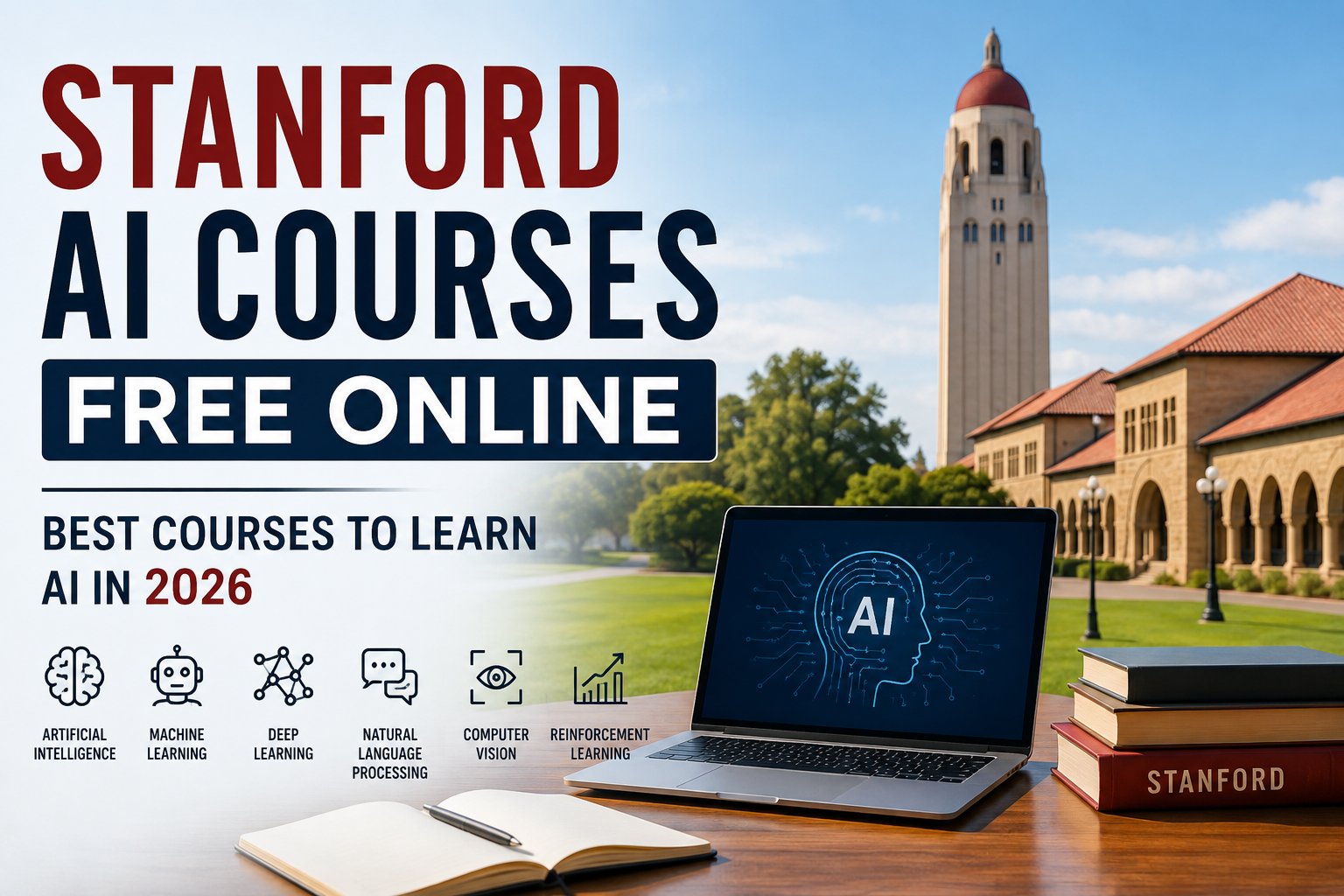
Want to learn artificial intelligence from Stanford without paying for a university degree? There are several Stanford AI courses free online that can help you study topics such as artificial intelligence, machine learning, deep learning, natural language processing, computer vision, and reinforcement learning.
If you’re specifically looking for Stanford AI courses free online, the good news is that several Stanford AI resources can be studied on the web without paying for course materials.
The important thing to understand is that “free” doesn’t always mean you are officially enrolled at Stanford. Some Stanford courses provide public lectures, archived materials, slides, assignments, or other resources, while current course enrollment and some course documents may be restricted to Stanford students.
Still, these resources can be incredibly useful if you’re serious about learning AI.
In this guide, we’ll look at the best Stanford AI courses to explore online, who each course is best for, what background you need, and how to choose the right one for your goals.
Are Stanford AI Courses Free Online?
Yes, some Stanford AI learning materials are available online at no cost. However, there is an important difference between free educational resources and free official enrollment.
Depending on the course, publicly available resources may include:
- Lecture videos
- Slides
- Course notes
- Reading materials
- Assignments
- Programming exercises
- Archived course websites
- Project examples
For example, Stanford’s CS234 reinforcement learning course provides lecture materials including slides and supporting resources online.
At the same time, not every current course makes every resource publicly accessible. The current CS229 page, for example, states that course documents require a Stanford email account.
So, if you’re searching for Stanford AI courses free online, think of them primarily as learning resources rather than assuming every course is a completely free, open enrollment program.
Best Stanford AI Courses Free Online
The following Stanford AI courses free online resources cover different areas of artificial intelligence. Here are some of the Stanford courses worth exploring, depending on your interests and current skill level.
1. Stanford CS221: Artificial Intelligence: Principles and Techniques
If you want to understand AI as a broader field, CS221: Artificial Intelligence: Principles and Techniques is a strong place to start.
Stanford describes CS221 as a course focused on the foundational concepts behind AI applications. Topics include search, constraint satisfaction, game playing, Markov decision processes, graphical models, machine learning, and logic.
You can find the current course description on the official Stanford CS221 page.
What can you learn from CS221?
The course can help you understand:
- Search and problem solving
- Decision making
- Probability
- Logic
- Machine learning
- Planning
- Markov decision processes
- AI algorithms
One thing to keep in mind is the prerequisite level. Stanford expects students to already have programming, probability, algorithms, and related computer science knowledge.
So while CS221 is a great AI foundation, it isn’t necessarily a course for someone who has never programmed before.
If you’re starting from scratch, you may want to build your programming foundation first and then return to CS221.
2. Stanford CS229: Machine Learning
If your main goal is to learn machine learning, CS229 is one of Stanford’s best-known options.
The course provides a broad introduction to machine learning and statistical pattern recognition. Topics include supervised learning, unsupervised learning, neural networks, support vector machines, clustering, dimensionality reduction, learning theory, and reinforcement learning.
For learners comparing Stanford AI courses free online, CS229 is one of the most useful options for building a machine learning foundation.
You can explore the official Stanford CS229 course page.
What background do you need?
CS229 is not designed as a completely beginner-friendly course.
Stanford expects students to have programming knowledge, probability, linear algebra, and related mathematical foundations. The current 2026 course listing also recommends a level of programming and mathematics equivalent to Stanford’s prerequisite courses.
That means I’d recommend this path:
Python → Mathematics → Basic AI → Machine Learning → CS229
If you already have that background, CS229 can be an excellent next step.
One important note for readers looking for completely open materials: the current CS229 course page says course documents require a Stanford email, so don’t assume that every current CS229 resource is publicly downloadable.
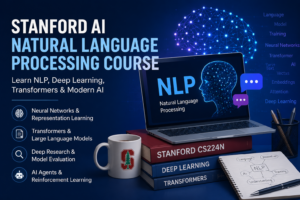
3. Stanford CS224N: Natural Language Processing With Deep Learning
Interested in NLP, language models, or large language models? CS224N should be high on your list.
Stanford’s CS224N focuses on natural language processing with deep learning. The course explores how neural networks can be used to process and understand human language.
The course has covered areas such as:
- Word representations
- Neural networks
- Language models
- Sequence models
- Attention
- Neural machine translation
- Transformers
- Deep learning for NLP
The 2026 Stanford CS224N course has also included project work involving modern language-model techniques, including GPT-2 fine-tuning and attention-related projects.
Among the Stanford AI courses available online, CS224N is particularly useful for anyone interested in NLP and LLMs.
You can explore the Stanford CS224N course resources.
Who should take CS224N?
I’d recommend CS224N if you’re interested in:
- NLP
- LLMs
- Language models
- AI assistants
- Machine learning research
- Text-based AI applications
It’s not where I’d send someone who has never heard of neural networks or machine learning, though. Having a basic ML foundation will make the material much easier to follow.
If you’re particularly interested in AI research, you can also pair this kind of learning with practical projects from your own portfolio.
4. Stanford CS231n: Deep Learning for Computer Vision
If language isn’t your main interest and you’d rather work with images, CS231n: Deep Learning for Computer Vision is the course to investigate.
Stanford’s Spring 2026 CS231n course focuses on deep learning techniques for visual recognition. The course includes concepts such as image classification, neural networks, optimization, and backpropagation.
Visit the official Stanford CS231n 2026 course page.
What can CS231n teach you?
You can expect to work with concepts related to:
- Image classification
- Convolutional neural networks
- Neural network optimization
- Backpropagation
- Visual recognition
- Deep learning
The course also includes a substantial project component. The 2026 course, for example, includes a final report and project work where students apply what they’ve learned to computer vision problems.
That practical side is one reason CS231n can be valuable for learners who want to move beyond simply watching lectures.
5. Stanford CS230: Deep Learning
Once you’ve learned the fundamentals of machine learning, deep learning is a natural direction to take.
CS230: Deep Learning covers the foundations of deep learning and how to build neural networks. Stanford’s course description includes topics such as convolutional networks, RNNs, LSTMs, optimization techniques, dropout, and batch normalization.
You can find the official Stanford CS230 course page.
The course is particularly relevant if you’re interested in:
- Neural networks
- Deep learning
- Computer vision
- NLP
- AI applications
- Machine learning projects
Stanford’s CS230 resources have also included lecture videos, programming assignments, quizzes, and project work, although access varies by resource and course offering.
If you’re still struggling with basic machine learning concepts, I’d learn those first rather than jumping directly into deep learning.
6. Stanford CS234: Reinforcement Learning
Reinforcement learning is another major area of AI, and Stanford’s CS234 provides a dedicated introduction to it.
The Winter 2026 course covers core reinforcement learning ideas as well as deep reinforcement learning and reinforcement learning from human feedback. Students work with lectures, written assignments, coding assignments, and a course project.
You can access the official Stanford CS234 course page and its lecture materials.
Who is CS234 for?
CS234 is particularly interesting if you want to learn about:
- Robotics
- Autonomous systems
- Game-playing AI
- Decision-making
- Reinforcement learning research
- RLHF
The prerequisites are significant. Stanford’s 2026 course expects Python proficiency, calculus, linear algebra, probability and statistics, plus a foundation in machine learning.
So again, this is not the course I’d recommend as your first step into AI.
Which Stanford AI Course Should You Choose?
You don’t need to take every Stanford AI course. In fact, trying to study all of them at once will probably slow you down.
A better approach is to choose based on your goal:
| Your Goal | Course to Explore |
|---|---|
| AI fundamentals | CS221 |
| Machine learning | CS229 |
| NLP and language AI | CS224N |
| Computer vision | CS231n |
| Deep learning | CS230 |
| Reinforcement learning | CS234 |
If you’re completely new to AI, start with foundational material.
If you already know programming, probability, and linear algebra, CS229 becomes much more realistic.
If you’re interested in ChatGPT-style systems and language models, CS224N is the obvious direction.
And if you’re more interested in images, visual recognition, or computer vision, CS231n makes more sense.
Don’t choose a course just because it has the Stanford name. Choose the one that fits what you actually want to build.
A Simple Stanford AI Learning Roadmap
You can turn these courses into a longer learning plan instead of treating them as isolated resources.
Step 1: Learn Python
Get comfortable with:
- Variables
- Functions
- Loops
- Data structures
- Classes
- NumPy
- Basic data manipulation
If you’re interested in practical AI tools as well as theory, you can also explore our guide to the best AI tools for beginners.
Step 2: Learn the Essential Math
You don’t need to become a mathematician, but you should understand:
- Linear algebra
- Probability
- Statistics
- Basic calculus
These topics appear repeatedly in machine learning and deep learning.
Step 3: Learn AI Fundamentals
Start with an introductory AI resource such as CS221.
Focus on understanding how AI systems approach problems rather than memorizing definitions.
Step 4: Move Into Machine Learning
Once your foundation is solid, study machine learning through CS229 or another rigorous ML course.
This is also a good point to start building small projects.
Step 5: Choose a Specialization
After learning machine learning, choose an area that matches your interests:
- NLP
- Computer vision
- Deep learning
- Reinforcement learning
- Robotics
- Generative AI
- AI research
If you’re interested in AI writing and language-based tools, you may also want to explore our best free AI writing tools guide alongside your technical studies.
Do Stanford AI Courses Give You a Free Certificate?
Not necessarily.
This is one of the most common misunderstandings around free university courses.
If you can watch a lecture or access course materials without paying, that doesn’t automatically mean you’ll receive an official Stanford certificate.
Likewise, being able to study an archived course online isn’t the same thing as being enrolled in the current Stanford class.
So before choosing a course, decide what you actually want:
Want to learn AI? Free course materials may be enough.
Want academic credit? You’ll need to check Stanford’s current enrollment requirements.
Want a certificate? Look at the specific Stanford program and its current credential options.
Don’t assume that every page labeled “free Stanford AI course” includes a certificate.
This distinction is especially important when you’re searching for Stanford AI courses free online with certificates.
How to Get More From Stanford’s Free AI Courses
Watching lectures from a famous university can feel productive, but passive learning has limits.
Try this instead.
Take your own notes. Don’t copy every slide. Write down the idea in your own words.
Attempt assignments. If programming exercises are available, try solving them before looking at solutions.
Build small projects. After learning classification, for example, build a simple classifier with a public dataset.
Keep a GitHub portfolio. Your projects can eventually demonstrate what you actually know.
Don’t rush advanced topics. Some Stanford courses are genuinely difficult. Spending several days understanding one concept is completely normal.
And if you’re learning AI for research, don’t stop at the lectures. Read papers, reproduce experiments, and try changing an existing implementation.
Are Stanford AI Courses Worth Taking for Free?
Yes, if your goal is to build a serious foundation in AI.
The biggest advantage is the depth and technical quality of the material. Stanford covers AI from several directions, from foundational reasoning and machine learning to NLP, computer vision, deep learning, and reinforcement learning.
The downside is that these courses aren’t necessarily designed for complete beginners.
Some require programming, probability, linear algebra, calculus, and previous machine learning knowledge. That’s especially clear from the prerequisites listed for CS221, CS229, and CS234.
So don’t feel bad if an advanced Stanford lecture seems difficult. It may simply be above your current level.
Final Thoughts
You don’t need to enroll at Stanford to start learning from Stanford’s AI resources.
For broad AI fundamentals, CS221 is a good course to explore. If machine learning is your main goal, look at CS229. For NLP and language models, CS224N is a strong choice. If you want computer vision, go toward CS231n, while CS230 and CS234 can take you deeper into deep learning and reinforcement learning.
The key is not to collect courses.
Pick one course that matches your current level, study it consistently, complete practical work, and build something of your own. Once you’ve genuinely understood the material, move to the next level.
That’s a much better way to turn Stanford AI courses free online into real-world AI skills.
With the right course and consistent practice, Stanford AI courses free online can become a valuable part of your AI learning journey.
About The Author