


Artificial intelligence can feel overwhelming when you are just getting started.
You may see terms like machine learning, neural networks, deep learning, natural language processing, and computer vision everywhere. Then you look at a Stanford AI course and wonder: “Is this really suitable for a beginner?”
The good news is that you do not need to be an AI expert before starting. Stanford offers a wide range of educational resources that can help learners build the foundations they need to understand modern artificial intelligence.
However, there is an important distinction: not every Stanford AI course is designed for complete beginners. Some courses assume that you already know programming, linear algebra, probability, or basic machine learning.
That is why choosing the right starting point matters.
In this guide, we will explore the best Stanford AI courses for beginners, what you should learn first, which courses are more advanced, what prerequisites you may need, and how you can create your own Stanford-inspired AI learning path.
If you’re just starting, our guide to AI Tools for Beginners can also help you discover practical tools to experiment with while learning.
What Are Stanford AI Courses?
Stanford University is one of the world’s most influential institutions in artificial intelligence research and education.
Its computer science and AI ecosystem includes courses covering machine learning, natural language processing, computer vision, robotics, reinforcement learning, and other areas of AI.
Stanford is also home to major AI research organizations, including the Stanford Artificial Intelligence Laboratory (SAIL) and the Stanford Institute for Human-Centered Artificial Intelligence (HAI).
For learners, the most interesting part is that many Stanford courses have publicly available course pages, lecture materials, assignments, or other learning resources.
This means you can often learn from Stanford’s educational material even if you are not enrolled as a Stanford student.
But there is a catch.
A course being available online does not automatically mean it is beginner-friendly.
Some Stanford courses move quickly and expect students to have a strong technical background. So, instead of simply choosing the most famous course, beginners should choose a course based on their current skill level.
Stanford’s AI ecosystem also includes the Stanford Artificial Intelligence Laboratory (SAIL), which has played an important role in AI research and education. Learning about SAIL can help beginners understand how Stanford’s academic work connects with real-world artificial intelligence research.
Are Stanford AI Courses Good for Beginners?
Yes, but with a qualification.
Stanford has excellent AI learning resources, but many of its well-known technical courses are designed for university students or learners who already have programming and mathematical foundations.
For example, a beginner who has never written a Python program may struggle if they immediately jump into an advanced machine learning course.
On the other hand, someone who already understands basic programming and wants to move into AI can find Stanford’s materials extremely valuable.
Think of it this way:
Stanford AI courses are not necessarily “easy” courses. They are high-quality courses that become much more approachable when you have the right foundation.
If you are completely new to AI, spend some time learning programming and basic mathematics first.
Best Stanford AI Courses for Beginners
There is no single “best” Stanford AI course for everyone.
Your ideal starting point depends on what you already know.
Here are some of the Stanford courses and subject areas worth exploring.
1. Stanford CS221 – Artificial Intelligence: Principles and Techniques
Stanford’s CS221 course is one of the most recognizable introductions to artificial intelligence.
The course explores fundamental AI concepts and techniques rather than focusing exclusively on one modern AI model or application.
Depending on the course version, topics can include areas such as:
- Search
- Decision making
- Probability
- Machine learning
- Logic
- Planning
- Sequential decision processes
- Natural language understanding
For a learner with some programming experience, CS221 can provide a broad understanding of what artificial intelligence entails.
However, I would not recommend treating it as a “zero knowledge required” course.
You will get much more from the material if you understand basic programming and have some familiarity with mathematics.
Best for: Beginners with some programming background who want a broad introduction to AI.
2. Stanford CS229 – Machine Learning
When people search for Stanford AI courses, CS229 is often among the first they discover.
Stanford’s CS229 focuses on machine learning, which is one of the core areas of modern AI.
The course covers concepts such as:
- Supervised learning
- Unsupervised learning
- Linear regression
- Logistic regression
- Neural networks
- Support vector machines
- Learning theory
- Generative models
CS229 is extremely valuable, but I would not recommend it as the first-ever technical course for someone who has never studied AI.
Why?
Because machine learning quickly becomes mathematical.
You should be comfortable with concepts from:
- Linear algebra
- Probability
- Calculus
- Basic statistics
- Programming
If those subjects are unfamiliar, don’t avoid CS229 forever. Instead, use it as a target.
Learn the prerequisites first, then return to it.
Best for: Learners who already know programming and basic mathematics and want a serious introduction to machine learning.
3. Stanford CS224N – Natural Language Processing
Interested in ChatGPT, language models, text generation, or AI assistants?
Then Stanford’s CS224N may be particularly interesting.
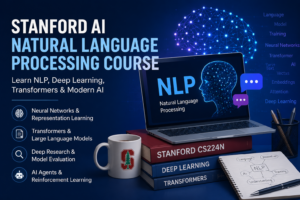
CS224N focuses on natural language processing (NLP), the area of AI concerned with understanding and generating human language.
The course covers important concepts behind modern language technology, including neural networks and representation learning.
For someone interested in today’s generative AI boom, NLP is an exciting area to explore.
However, CS224N is generally not a course I would recommend to someone who has never programmed before.
A better strategy is to first learn Python, basic machine learning, and neural network fundamentals.
Then CS224N becomes much easier to appreciate.
Best for: Intermediate learners interested in NLP, large language models, and language-based AI.
4. Stanford CS231N – Computer Vision
What if you are more interested in images and video than text?
That’s where computer vision comes in.
Stanford’s CS231N is associated with deep learning for computer vision and is particularly well known for its treatment of convolutional neural networks and visual recognition.
You may encounter topics such as:
- Image classification
- Object detection
- Convolutional neural networks
- Neural network architectures
- Image processing
- Deep learning
Computer vision is behind many technologies, from facial recognition and medical imaging to autonomous vehicles and visual search.
Again, CS231N is better suited to learners who already have some technical background.
If you are a complete beginner, start with Python and basic machine learning before diving into this material.
Best for: Learners interested in image-based AI and deep learning.
What Should a Complete Beginner Learn First?
If you have never studied AI before, don’t worry.
You do not need to learn everything at once.
A simple progression can make the journey much less intimidating.
Step 1: Learn Basic Python
Python is one of the most commonly used programming languages in AI and machine learning.
Before studying technical AI material, make sure you understand:
- Variables
- Functions
- Loops
- Conditional statements
- Lists and dictionaries
- Classes and objects
- Basic file handling
- Libraries and packages
You don’t need to become a professional software developer.
You simply need enough Python to read and write basic programs.
Step 2: Learn Basic Mathematics
You don’t need to become a mathematician, but some mathematics will make AI much easier to understand.
Focus on:
Linear algebra: vectors, matrices, matrix multiplication.
Probability: probability distributions, conditional probability, expectation.
Statistics: mean, variance, standard deviation, correlation.
Calculus: derivatives and gradients.
The goal isn’t to memorize hundreds of formulas.
The goal is to understand what the formulas are trying to accomplish.
Step 3: Understand Basic Machine Learning
Before jumping into deep learning or large language models, understand what machine learning actually means.
Learn concepts such as:
- Training data
- Features
- Labels
- Training and testing
- Overfitting
- Underfitting
- Model evaluation
- Classification
- Regression
Once these ideas make sense, advanced AI courses become much less confusing.
Step 4: Start a Stanford Course
Now you can begin exploring Stanford material.
For a broad AI introduction, look at CS221.
If machine learning interests you, move toward CS229.
If language AI interests you, eventually explore CS224N.
If images and vision interest you, explore CS231N.
This approach is much better than trying to complete every Stanford course simultaneously.
Can You Take Stanford AI Courses for Free?
Some Stanford course materials are publicly available online, but “free course materials” and “free enrollment in a Stanford degree course” are not the same thing.
Publicly available materials may include lecture notes, assignments, readings, videos, or other resources depending on the course.
Before starting, check the current official course page to see exactly what is available.
Also keep in mind that access to course materials does not necessarily mean you receive Stanford academic credit or an official Stanford credential.
That distinction is important if you are learning for your career.
If your goal is knowledge, public course resources can be incredibly useful.
If your goal is an official qualification, you should investigate Stanford’s formal programs separately.
You can also find more options in our collection of Free AI Tools for learning, experimentation, and everyday tasks.
Do You Need to Be a Stanford Student?
No, you don’t need to be a Stanford student to learn from publicly available Stanford AI resources.
This is one of the biggest advantages for independent learners.
You can study the concepts, watch available lectures, work through exercises, read recommended papers, and build projects based on what you learn.
But remember that self-study requires discipline.
No professor is standing next to you reminding you to finish the assignment.
You need to create your own schedule.
Even 60–90 minutes of focused study per day can produce meaningful progress if you remain consistent.
Students can also explore our guide to AI Tools for Students for practical ways to use AI while studying.
Stanford AI Courses vs. Beginner AI Courses
You might be wondering:
“Why should I study Stanford material instead of taking an easier beginner course?”
That’s a fair question.
Beginner-oriented platforms often do a better job of slowly introducing concepts.
Stanford courses, on the other hand, can provide a more academically rigorous perspective.
A good strategy is actually to combine both.
Use a beginner-friendly resource to understand a difficult concept.
Then use Stanford’s material to study the subject more deeply.
For example:
Beginner resource → understand the idea → Stanford course → study the mathematics → build a project.
This combination can be much more effective than relying entirely on one resource.
A Beginner-Friendly Stanford AI Learning Path
If I were starting AI from scratch today, I would avoid trying to learn everything simultaneously.
Instead, I would use a progression like this:
Month 1: Programming
Focus primarily on Python.
Build small projects such as:
- Calculator
- Text analyzer
- Simple data cleaner
- Basic chatbot
- Number prediction game
The projects don’t need to be impressive.
The purpose is to become comfortable writing code.
Month 2: Mathematics + Data
Start learning basic statistics, probability, and linear algebra.
At the same time, learn how Python libraries such as NumPy and pandas work.
Start working with small datasets.
Month 3: Machine Learning Fundamentals
Learn regression, classification, model evaluation, overfitting, and feature engineering.
Build a few small machine learning projects.
Month 4: Stanford CS221 or Equivalent AI Fundamentals
Now begin exploring broader AI concepts.
Don’t worry if some lectures feel difficult.
Pause.
Research the unfamiliar concept.
Try implementing a simple version.
Then continue.
Month 5–6: Choose a Specialization
This is where you can choose your direction.
Interested in language? Explore NLP and eventually CS224N.
Interested in images? Explore computer vision and CS231N.
Interested in general machine learning? Go deeper into CS229.
Interested in AI systems and decision making? Continue exploring broader AI topics.
This specialization approach prevents you from becoming overwhelmed.
What Makes Stanford AI Courses Difficult?
One reason Stanford courses can feel challenging is that they often move beyond surface-level explanations.
You may encounter mathematical notation, research papers, algorithms, and programming assignments.
That’s not necessarily a bad thing.
Difficulty often means you are moving beyond memorizing definitions and actually learning how AI systems work.
But there is a difference between productive difficulty and unnecessary frustration.
If you spend two hours looking at a mathematical derivation and don’t understand what any of it means, go back one step.
Learn the prerequisite.
Then return.
Learning AI isn’t a race.
Should Beginners Start With Generative AI Instead?
Generative AI is probably the most exciting area of AI for many new learners.
Tools such as ChatGPT have made people curious about how large language models work.
But there’s a temptation to skip the fundamentals.
You can certainly experiment with generative AI immediately.
In fact, I recommend it.
Build a simple chatbot.
Try an API.
Experiment with prompts.
Create a document summarizer.
But if you want to understand what happens underneath the interface, eventually you need to study machine learning, neural networks, optimization, and NLP.
Stanford’s more advanced AI courses can help you make that transition from AI user to AI learner and builder.
Stanford’s AI work also extends beyond technical development. The Stanford Institute for Human-Centered Artificial Intelligence (HAI) focuses on understanding how AI can be developed and used in ways that benefit people and society. For beginners, exploring HAI can provide useful context about the broader impact of artificial intelligence.
How to Get the Most From a Stanford AI Course
Simply watching lectures isn’t enough.
If you want real skills, use a three-part approach.
Watch
Follow the lectures and take notes.
Don’t try to write down every sentence.
Write down ideas you don’t understand and concepts you want to investigate.
Implement
Whenever possible, write code.
If the course explains a machine learning algorithm, try implementing a simplified version.
Coding turns abstract concepts into something concrete.
Build
After finishing a topic, create something.
For example, after learning classification, build a spam classifier.
After studying NLP, create a text classification project.
After learning computer vision, build an image classifier.
Projects give your learning a purpose.
Common Mistakes Beginners Make
Starting With the Hardest Course
A famous course isn’t necessarily the right first course.
Choose based on your current level.
Ignoring Mathematics
You can begin AI without advanced mathematics, but eventually mathematics becomes important.
Don’t avoid it forever.
Watching Without Practicing
AI knowledge becomes much more valuable when you can implement it.
Trying to Learn Everything
Machine learning, NLP, robotics, computer vision, reinforcement learning, and generative AI are huge fields.
You don’t need to master all of them.
Choose one direction first.
Comparing Your Progress With Others
Some learners already have years of programming experience.
Others are starting from zero.
Your progress should be measured against where you were last month, not where someone else is today.
Is Stanford AI Worth Learning for Beginners?
Absolutely—if you approach it realistically.
Stanford’s AI ecosystem can give you exposure to rigorous academic material and some of the ideas that have shaped modern AI research.
But you don’t have to begin with the hardest material.
Start with programming.
Build your mathematical foundation.
Understand basic machine learning.
Then gradually move into Stanford’s more advanced AI courses.
The biggest mistake is thinking you need to understand everything before you start.
You don’t.
You only need to understand the next step.
Final Thoughts
Finding the right Stanford AI courses for beginners can be a great starting point for anyone who wants to take artificial intelligence seriously.
Just remember that Stanford’s best-known AI courses are not all designed for complete beginners.
If you’re starting from zero, begin with Python and foundational mathematics. Then learn basic machine learning concepts before moving into courses such as CS221, CS229, CS224N, or CS231N.
And don’t make the mistake of turning AI learning into a lecture-watching marathon.
Learn a concept.
Write some code.
Build something small.
Get stuck.
Figure out why.
Then move forward.
That’s where the real learning happens.
Stanford can provide the educational material, but you provide the curiosity, consistency, and practice.
If you follow a gradual learning path instead of trying to master everything at once, even a complete beginner can eventually work through serious Stanford-level AI material.
About The Author